
Team Details
As of 2022, this class has been integrated into the other two classes.
Revolve NTNU Driverless
| University | Norwegian University of Science and Technology
NO Trondheim NTNU short 738 |
 |
|---|---|---|
| Location | Trondheim, Norway | |
| Homepage | https://www.revolve.no/ | |
| Social Media | ||
| CV Team | Revolve NTNU | |
| EV Team | Revolve NTNU | |
| Short Link | tid.fsg.one/821 | |
Team Description
Revolve NTNU Driverless
Past Events
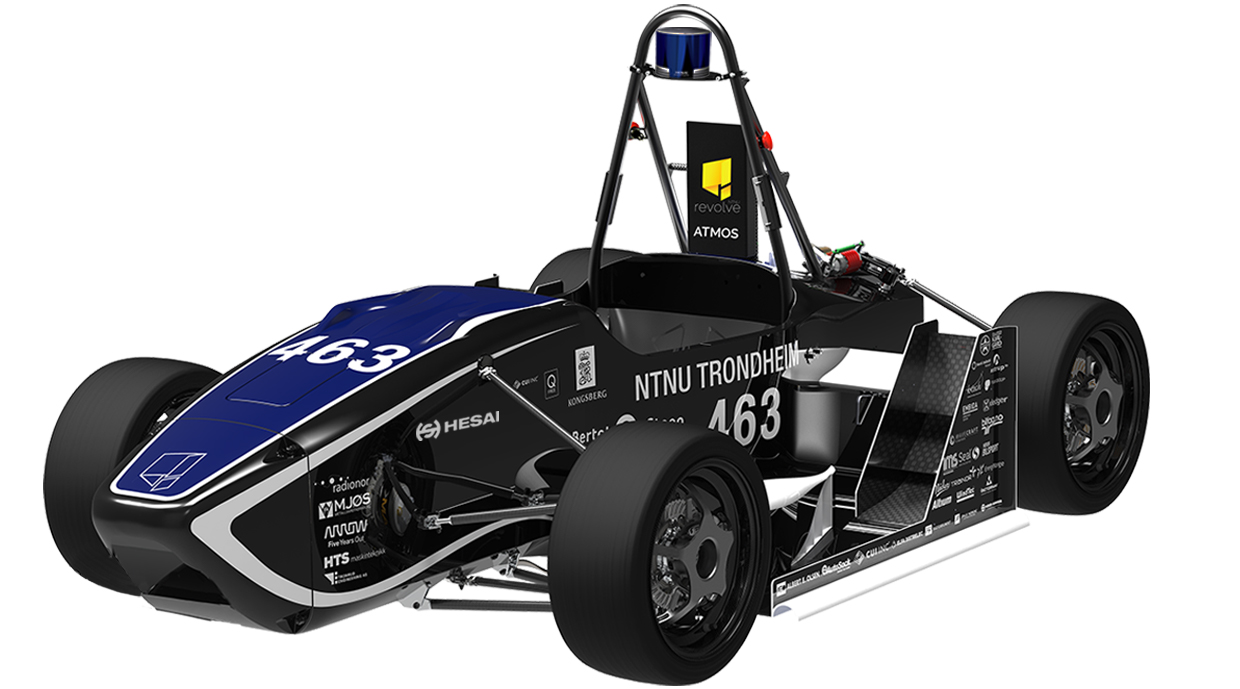
2021
Info
126x
Revolve NTNU was founded in 2010. We developed two combustion cars, before switching to electric in 2014 and had our first 4wd electric car in 2016. Since 2018 we have been developing both an autonomous and an electric racecar each year. Last year’s vehicles were unfortunately never completed, so we are really looking forward to showing you everything we have been working on over the past two years. See you at FSG.
Engineering Design Priorities:
Reliability
Repeatability
Technical Maintainability
Autonomous Control
State Estimation & SLAM
Software Development
Car Specifications
General
| Frame Construction | CFRP Two-Piece Monocoque |
|---|---|
| Material | M 2x2 twill prepreg and HM UD prepreg with Foam & ALUHC core sandwich panel |
| Overall L | 2870 mm |
| Overall W | 1400 mm |
| Overall H | 1185 mm |
| Wheelbase | 1530 mm |
| Track (Fr) | 1200 mm |
| Track (Rr) | 1180 mm |
| Weight with 68kg driver (Fr) | 96 kg |
| Weight with 68kg driver (Rr) | 105 kg |
| Suspension | SLA, upper wishbone push rod actuated |
| Tyres (Fr / Rr) | 205x34 R13 - Continental C17, front and rear |
| Wheels (Fr / Rr) | 7x13, 36mm offset, two pc CFRP/Al Rim, front and rear |
| Drive Type | Hub mounted compound planetary gearbox |
| Differential | N/A |
| Cooling | Dual cycle, rear-mounted w/ fans and ducting. |
| Brake System | 4-Disk system, self developed rotors, ISR 22-048/9 callipers, adjustable brake balance |
| Electronics | All PCB's except IMD, telemetry and the inverter are self developed. |
Powertrain
| Number of Motors | 4 |
|---|---|
| Motor Location | Hub mounted |
| Max Motor Power (per motor) | 37 kW kW |
| Motor Type | AMK DD5-14-10-POW-18600-B5 |
| Max Motor RPM (highest) | 20.000 rpm |
| Motor Controller | AMK KW26-S5-FSE-4Q |
| Max System Voltage | 588V V |
| Electrode Materials | LiCoO2 |
| Combined Accumulator Capacity | 6.8 kWh kWh |
| Transmission Ratio (Primary) | 1:15.58 : 1 |
| Transmission Ratio (Secondary) | N/A : 1 |
Driverless System
| Processing unit(s) | Self developed processing unit with Intel i9-9900 |
|---|---|
| Floating Point Operations Per Second of all processing units that are working for the DV system | 499 GigaFLOPS |
| Power consumption of all processing units that are working for the DV system | 105 W |
| Camera(s) | N/A |
| Radar sensor(s) | N/A |
| Lidar sensor(s) | Hesai Pandar P40 |
| Other sensors | VectorNav VN-300 INS |
| Highlights of the DV system | Autonomous systems are crafted in C++ and Python with ROS. Detection with single LiDAR and PCL. ESKF State Estimation using IMU and dual GNSS with pose feedback from graphSLAM. Path planning using particle filter. Coupled MPCC controller seeking optimal wheel angles and torques, maximizing progress around track. Tested using in-house simulation. |
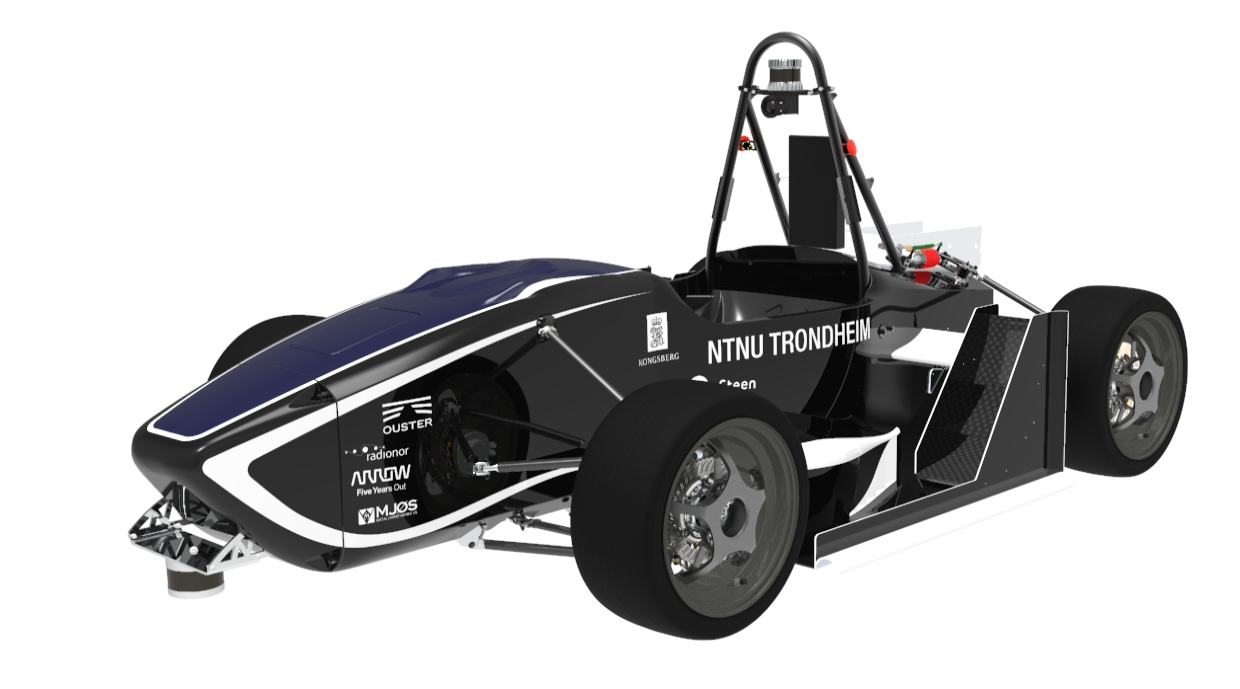
2019
Info
12x
Revolve NTNU is a team from Norway, consisting of 67 students from all years of study. This year, over 15 members have worked hard to introduce Revolve's second autonomous vehicle. With a new base vehicle and a new autonomous pipeline, we will do our best in the competitions. Best of luck to everyone!
Engineering Design Priorities:
Particle Filter Planning
SLAM Frontend w/EKF
Asynchronous Detection
Custom Processing Unit
Sensor Testing
Car Maintainability
Car Specifications
General
| Frame Construction | CFRP Two-Piece Monocoque |
|---|---|
| Material | IM 2x2 twill prepreg and HM UD prepreg with Foam & ALUHC core sandwich panel |
| Overall L | 2870 mm |
| Overall W | 1400 mm |
| Overall H | 1185 mm |
| Wheelbase | 1530 mm |
| Track (Fr) | 1200 mm |
| Track (Rr) | 1180 mm |
| Weight with 68kg driver (Fr) | 96 kg |
| Weight with 68kg driver (Rr) | 105 kg |
| Suspension | SLA, upper wishbone push rod actuated |
| Tyres (Fr / Rr) | 205x34 R13 - Continental C17, front and rear |
| Wheels (Fr / Rr) | 7x13, 36mm offset, two pc CFRP/Al Rim, front and rear |
| Drive Type | Hub mounted compound planetary gearbox |
| Differential | N/A |
| Cooling | Dual cycle, mounted inside sidepod w/ fans and ducting. |
| Brake System | 4-Disk system, self developed rotors, ISR 22-048/9 calipers, adjustable brake balance |
| Electronics | All PCB's except IMD, telemetry and the inverter are self developed. |
Powertrain
| Number of Motors | 4 |
|---|---|
| Motor Location | Hub mounted |
| Max Motor Power (per motor) | 37 kW kW |
| Motor Type | AMK DD5-14-10-POW-18600-B5 |
| Max Motor RPM (highest) | 20.000 rpm |
| Motor Controller | AMK KW26-S5-FSE-4Q |
| Max System Voltage | 588 V |
| Electrode Materials | LiCoO2 |
| Combined Accumulator Capacity | 6.8 kWh kWh |
| Transmission Ratio (Primary) | 1:15.58 : 1 |
| Transmission Ratio (Secondary) | N/A : 1 |
Driverless System
| Processing unit(s) | Self developed processing unit with Intel i7-8700, NVIDIA GTX 1070 |
|---|---|
| Floating Point Operations Per Second of all processing units that are working for the DV system | 6825 GigaFLOPS |
| Power consumption of all processing units that are working for the DV system | 250 W |
| Camera(s) | Basler acA1300-200uc |
| Radar sensor(s) | N/A |
| Lidar sensor(s) | Ouster - OS-1, Velodyne - Puck VLP-16 |
| Other sensors | VectorNav VN-300 |
| Highlights of the DV system | Autonomous systems written in C++ in ROS. Nonlinear observer for state estimation. Detection systems based on mono camera and 2xLiDARs using YOLOv3 and PCL, fused asynchronously with EKF in SLAM frontend. SLAM’s backend is factor graph based (iSAM2). Particle Filter based path planning. Feedback Linearization Control. Tested on inhouse simulator. |
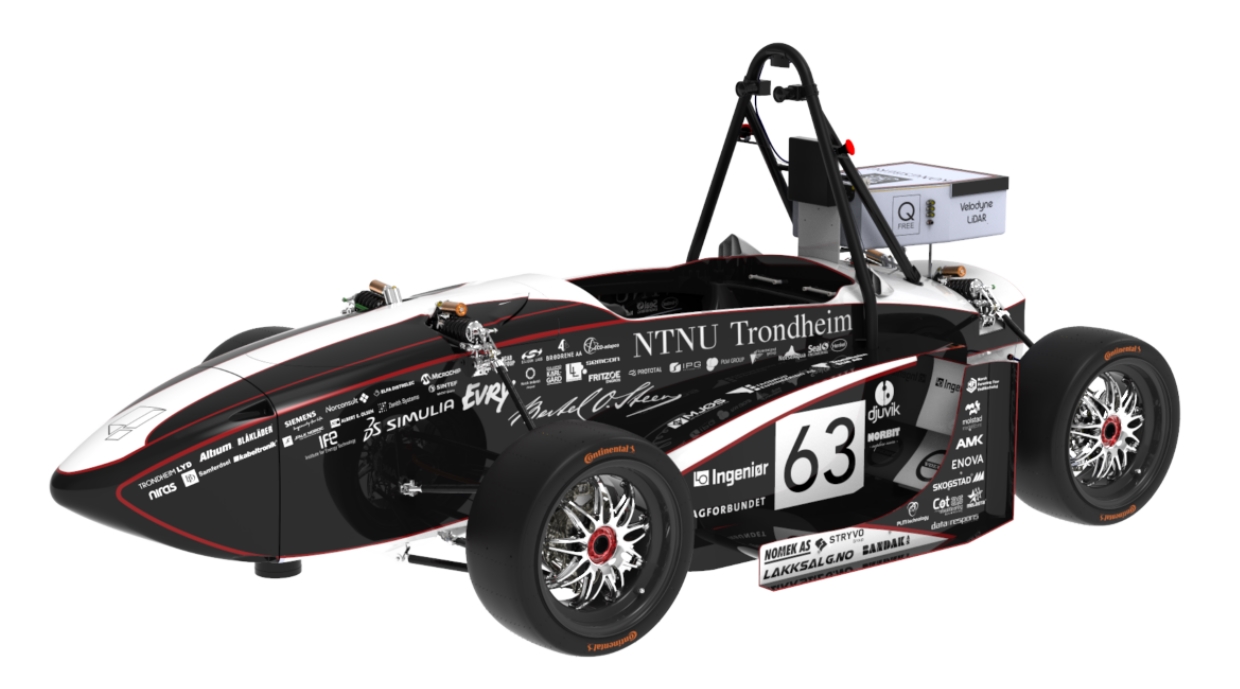
2018
Info
50x
Revolve NTNU is a team from Norway, consisting of 70 students from all years of study. We decided early to join the new challenge of driverless and followed closely as the first FSD competition was held in 2017. This year our 20 members on the driverless team have been working hard to place Trondheim on the map of autonomous racing, resulting in a solid system based on the combination of Machine Learning and classical AI.
Engineering Design Priorities:
End-to-End ML system
Neural net cone detection
Detailed graphSLAM
Model Predictive Control
Traxxas test platform
Gazebo-simulation
Car Specifications
General
| Frame Construction | Full CFRP monocoque |
|---|---|
| Material | CFRP, AlHC and Rohacell sandwich construction |
| Overall L | 2630 mm |
| Overall W | 1400 mm |
| Overall H | 1186 mm |
| Wheelbase | 1530 mm |
| Track (Fr) | 1200 mm |
| Track (Rr) | 1180 mm |
| Weight with 68kg driver (Fr) | 73 kg |
| Weight with 68kg driver (Rr) | 108 kg |
| Suspension | Double unequal length A-arm. Push rod actuated horizontally oriented spring and damper. |
| Tyres (Fr / Rr) | 205/470 R13 Continental C17 front and rear |
| Wheels (Fr / Rr) | 7.0x13”, 2pc Al/CFRP rim front and rear |
| Drive Type | Hub mounted compound planetary gear box |
| Differential | N/A |
| Cooling | Dual cycle water cooling on motor and controller. Air cooled Accumulator. |
| Brake System | Self developed discs (186mm) and brake balance adjuster. ISR front and rear calipers. |
| Electronics | Self-designed AMS, ADC’s and Dashboard. Livedash and self-developed analyze program. |
Powertrain
| Number of Motors | 4 |
|---|---|
| Motor Location | FR, FL, RR, RL |
| Max Motor Power (per motor) | 4x37kW kW |
| Motor Type | 4 x AMK/DD5-14-10-POW |
| Max Motor RPM (highest) | 20000 rpm |
| Motor Controller | AMK /KW26-S5-FSE-4Q |
| Max System Voltage | 504V V |
| Electrode Materials | LiCoO2 |
| Combined Accumulator Capacity | 5.81 kWh |
| Transmission Ratio (Primary) | 15.46:1 : 1 |
| Transmission Ratio (Secondary) | N/A : 1 |
Driverless System
| Processing unit(s) | Nvidia Drive PX2 Auto Chauffeur |
|---|---|
| Floating Point Operations Per Second of all processing units that are working for the DV system | 16000 GigaFLOPS |
| Power consumption of all processing units that are working for the DV system | 150 W |
| Camera(s) | 2 color-vision FLIR Blackfly mounted in main hoop |
| Radar sensor(s) | N/A |
| Lidar sensor(s) | Velodyne Puck VLP-16, mounted below monocoque |
| Other sensors | Swift Nav Piksi Multi RTK and Vector Nav VN-200 INS |
| Highlights of the DV system | Both end-2-end machine learning and full driving pipeline. Cone-detection combining LiDAR and camera with ML classifier and YOLO3 as redundant systems. Fully functional graphSLAM, and trackfinder using triangulation and circles. Model Predictive Contouring Control for high speed driving. Early testing with Gazebo and Traxxas XO-1 RC car. |
FS past achievements due to World Ranking Data Base
| Date | Event | Teams | Rank | BP | CM | ED | DV SP | DV AC | AX | EN | EF | Pe | Total | Engine |
|---|---|---|---|---|---|---|---|---|---|---|---|---|---|---|
| 2026.08 | 39 |
2. |
- |
- |
13. |
8. |
5. |
3. |
3. |
- |
0.00 |
480.07 |
||
| 2026.07 | 27 |
3. |
- |
- |
2. |
- |
- |
1. |
2. |
- |
0.00 |
449.08 |
||
| 2025.08 | 42 |
8. |
- |
- |
2. |
1. |
2. |
9. |
12. |
- |
0.00 |
346.71 |
||
| 2025.08 | 24 |
1. |
- |
- |
1. |
5. |
2. |
2. |
2. |
- |
-20.00 |
852.25 |
||
| 2024.08 | 27 |
9. |
- |
- |
2. |
- |
3. |
- |
- |
- |
0.00 |
202.56 |
||
| 2024.08 | 13 |
5. |
1. |
3. |
3. |
2. |
2. |
- |
- |
- |
0.00 |
561.64 |
||
| 2023.08 | 30 |
17. |
- |
- |
9. |
- |
- |
- |
- |
- |
0.00 |
100.00 |
||
| 2023.08 | 22 |
9. |
6. |
12. |
14. |
7. |
1. |
- |
- |
- |
0.00 |
425.18 |
||
| 2022.08 | 19 |
10. |
- |
- |
8. |
8. |
- |
- |
- |
- |
0.00 |
129.84 |
||
| 2022.08 | 22 |
14. |
13. |
13. |
14. |
- |
- |
- |
- |
- |
0.00 |
343.11 |
||
| 2021.08 | 17 |
5. |
8. |
12. |
9. |
4. |
- |
3. |
4. |
- |
0.00 |
347.11 |
||
| 2019.08 | 20 |
15. |
7. |
15. |
10. |
- |
- |
- |
- |
- |
-32.00 |
261.83 |
||
| 2019.07 | 14 |
10. |
8. |
11. |
7. |
- |
- |
- |
- |
- |
0.00 |
363.40 |
||
| 2018.08 | 17 |
7. |
11. |
8. |
6. |
- |
- |
- |
6. |
- |
-15.00 |
297.77 |
||
| 2018.07 | 7 |
2. |
1. |
1. |
1. |
- |
- |
- |
- |
- |
0.00 |
492.00 |
||
| x 15 | ||||||||||||||