
Team Details
As of 2022, this class has been integrated into the other two classes.
AMZ Driverless
| University | ETH Zürich
CH Zürich ETH short 94 |
 |
|---|---|---|
| Location | Zürich, Switzerland | |
| Homepage | https://amzracing.ch | |
| Social Media | ||
| CV Team | Akademischer Motorsportverein Zürich | |
| EV Team | AMZ Racing Team | |
| Short Link | tid.fsg.one/785 | |
Team Description
The Academic Motorsports Club Zurich (AMZ) was founded in 2006 by students of ETH Zurich and has produced a prototype to compete in various «Formula Student» competitions in Europe every year since then. After having built three combustion powered cars, AMZ moved forward to developing fully electric racing cars in 2010. With the introduction of the Formula Student Driverless class in 2017, AMZ became a pioneer in developing autonomous race cars. Since then, AMZ engineers a new driverless race car on the basis of a vehicle from previous years in addition to the new electric one every season.
Past Events
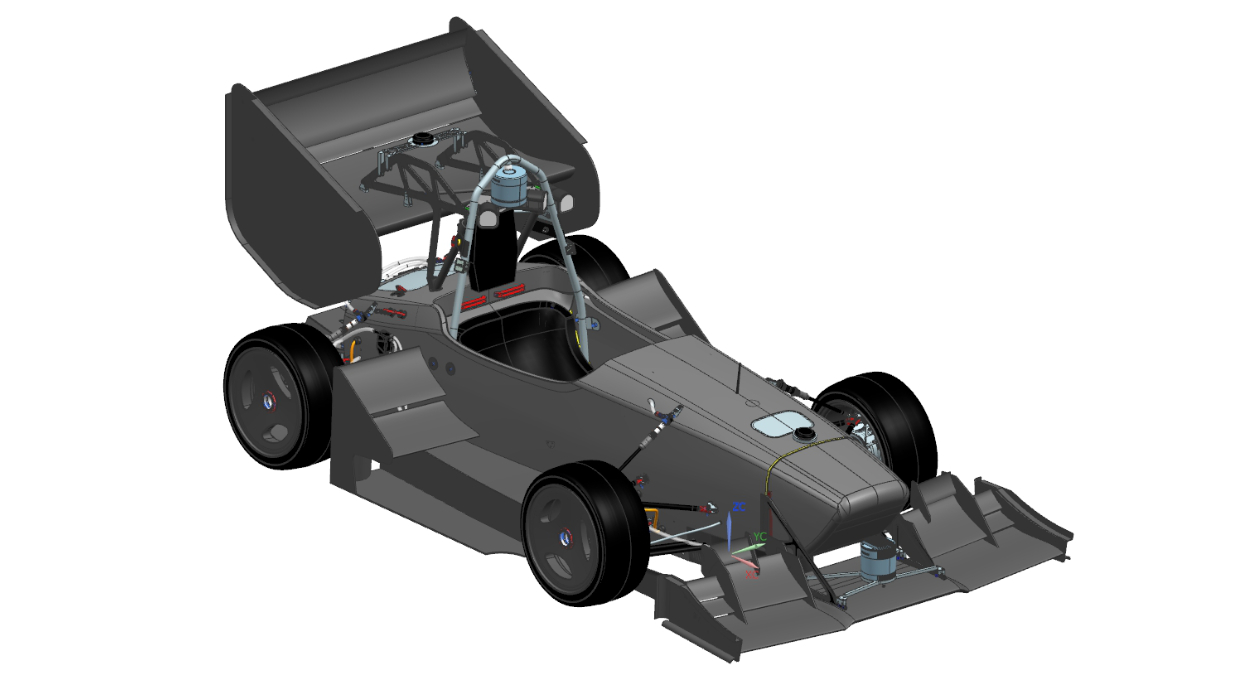
2021
Info
49x
AMZ Racing was founded in 2006 by students of ETH Zurich. Since 2010 AMZ focuses on electric vehicles and collaborates with the Lucerne University of Applied Science and Arts. AMZ took the opportunity to transform their electric vehicles into autonomous race cars, when Driverless was first introduced in 2017. The 2019 driverless team consists of an diverse and international team of Master's students from Robotics, Electrical Engineering, Mechanical Engineering, and Computer Science.
Engineering Design Priorities:
Hardware reliability
Software reliability
Lap time reduction
Innovative design
Complexity reduction
Simulation
Car Specifications
General
| Frame Construction | Single piece CFRP monocoque |
|---|---|
| Material | CFRP & AFRP pre-preg (Twill and UD), aluminum honeycomb sandwich |
| Overall L | 2932 mm |
| Overall W | 1422 mm |
| Overall H | 1156 mm |
| Wheelbase | 1530 mm |
| Track (Fr) | 1220 mm |
| Track (Rr) | 1220 mm |
| Weight with 68kg driver (Fr) | 97 kg |
| Weight with 68kg driver (Rr) | 100 kg |
| Suspension | A-arms and pushrods, hydraulically actuated, mode decoupled suspension with MRF dampers |
| Tyres (Fr / Rr) | 18.3x7.0-13, Continental C17 |
| Wheels (Fr / Rr) | OZ Racing Aluminum 7Jx13 |
| Drive Type | Self-developed AMZ M7 motors |
| Differential | - |
| Cooling | Single water circuit with two pumps and two radiators for motors, inverters, and computing units |
| Brake System | Self-developed aluminum calipers, adjustable brake balance, proportional valve in the rea |
| Electronics | Self-developed optical AMS, CAN nodes, and 868MHz telemetry system |
Powertrain
| Number of Motors | 4 |
|---|---|
| Motor Location | On all wheels |
| Max Motor Power (per motor) | 38.44kW kW |
| Motor Type | Permanent magnet synchronous inrunners |
| Max Motor RPM (highest) | 24000 1/min rpm |
| Motor Controller | Lenze-Schmidhauser Dual DCU |
| Max System Voltage | 462 V |
| Electrode Materials | LiCoO2 |
| Combined Accumulator Capacity | 6.2kWh kWh |
| Transmission Ratio (Primary) | 1:18.28 : 1 |
| Transmission Ratio (Secondary) | - |
Driverless System
| Processing unit(s) | CPU: Intel Quad-Core Xeon E3-1505M V6, GPU: NVIDIA GeForce RTK 3060 |
|---|---|
| Floating Point Operations Per Second of all processing units that are working for the DV system | - |
| Power consumption of all processing units that are working for the DV system | 210 W |
| Camera(s) | 3 Basler cameras with a combined opening angle of 135° and overlapping FOVs |
| Radar sensor(s) | - |
| Lidar sensor(s) | Hesai Pandar 20 & 64 |
| Other sensors | INS with dual antenna GNSS, non-contact optical speed sensor |
| Highlights of the DV system | Fully redundant sensor pipelines providing robustness against single sensor failure. Multi-level estimation methods leverage probabilistic cone observations. Different control algorithms are optimized to meet the requirements of the respective dynamic disciplines. |
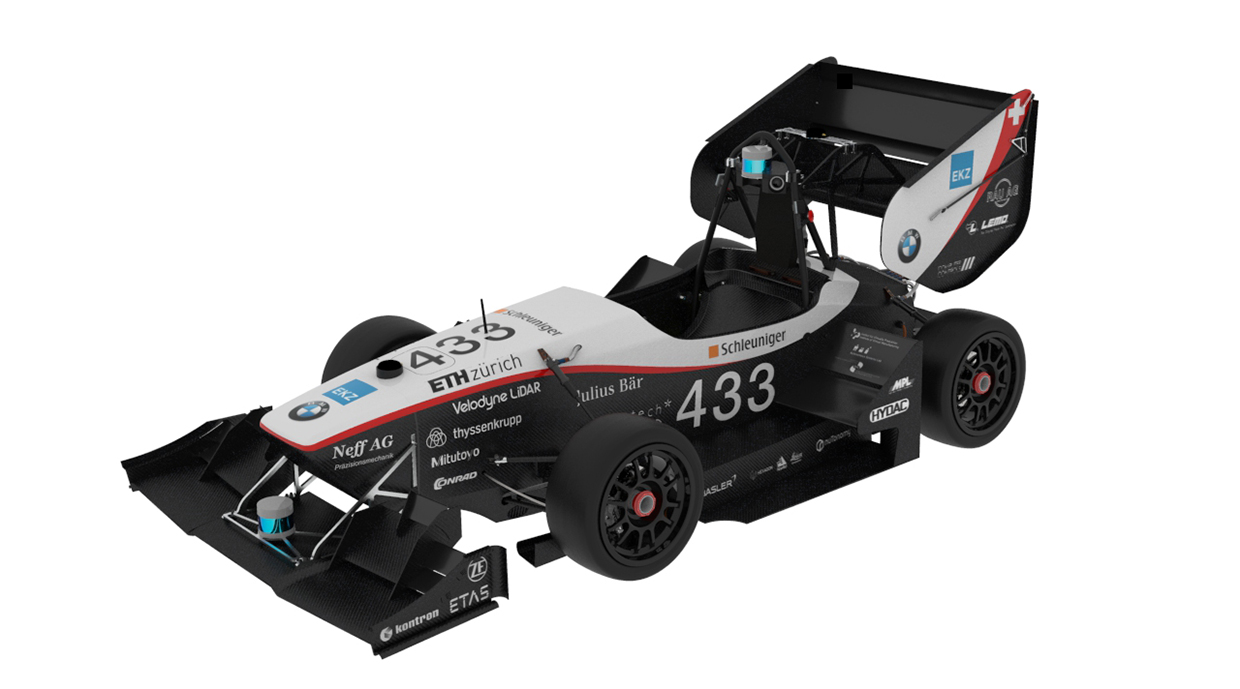
2019
Info
126x
AMZ Racing was founded in 2006 by students of ETH Zurich. Since 2010 AMZ focuses on electric vehicles and collaborates with the Lucerne University of Applied Science and Arts. AMZ took the opportunity to transform their electric vehicles into autonomous race cars, when Driverless was first introduced in 2017. The 2019 driverless team consists of an diverse and international team of Master's students from Robotics, Electrical Engineering, Mechanical Engineering, and Computer Science.
Engineering Design Priorities:
Hardware reliability
Lap time reduction
Robust algorithms
Simulation
Redundant sensor setup
Early failure detection
Car Specifications
General
| Frame Construction | Single piece CFRP monocoque |
|---|---|
| Material | CFRP & AFRP pre-preg (Twill and UD), aluminum honeycomb sandwich |
| Overall L | 2932 mm |
| Overall W | 1422 mm |
| Overall H | 1156 mm |
| Wheelbase | 1530 mm |
| Track (Fr) | 1220 mm |
| Track (Rr) | 1220 mm |
| Weight with 68kg driver (Fr) | 97 kg |
| Weight with 68kg driver (Rr) | 100 kg |
| Suspension | A-arms and pushrods, hydraulically actuated, mode decoupled suspension with MRF dampers |
| Tyres (Fr / Rr) | 18.3x7.0-13, Continental C17 |
| Wheels (Fr / Rr) | OZ Racing Aluminum 7Jx13 |
| Drive Type | Self-developed AMZ M7 motors |
| Differential | - |
| Cooling | Single water circuit with two pumps and two radiators for motors, inverters, and computing units |
| Brake System | Self-developed aluminum calipers, adjustable brake balance, proportional valve in the rear |
| Electronics | Self-developed optical AMS, CAN nodes, and 868MHz telemetry system |
Powertrain
| Number of Motors | 4 |
|---|---|
| Motor Location | On all wheels |
| Max Motor Power (per motor) | 38.44kW kW |
| Motor Type | Permanent magnet synchronous inrunners |
| Max Motor RPM (highest) | 24000 1/min rpm |
| Motor Controller | Lenze-Schmidhauser Dual DCU |
| Max System Voltage | 462V V |
| Electrode Materials | LiCoO2 |
| Combined Accumulator Capacity | 6.2kWh kWh |
| Transmission Ratio (Primary) | 1:18.28 : 1 |
| Transmission Ratio (Secondary) | - |
Driverless System
| Processing unit(s) | CPU: Intel Quad-Core Xeon E3-1505M V6, GPU: NVIDIA GeForce 1070 |
|---|---|
| Floating Point Operations Per Second of all processing units that are working for the DV system | 6660 GigaFLOPS |
| Power consumption of all processing units that are working for the DV system | 210 W |
| Camera(s) | Two Basler mono cameras with a combined opening angle of 135° enabling cone detections up to 20m |
| Radar sensor(s) | - |
| Lidar sensor(s) | Two Velodyne ULTRA Pucks with a horizontal field of view of 180° enabling cone detections up to 25m |
| Other sensors | INS with dual antenna GNSS, non-contact optical speed sensor |
| Highlights of the DV system | Fully redundant sensor pipelines providing robustness against single sensor failure. Multi-level estimation methods leverage probabilistic cone observations. Different control algorithms are optimized to meet the requirements of the respective dynamic disciplines. |
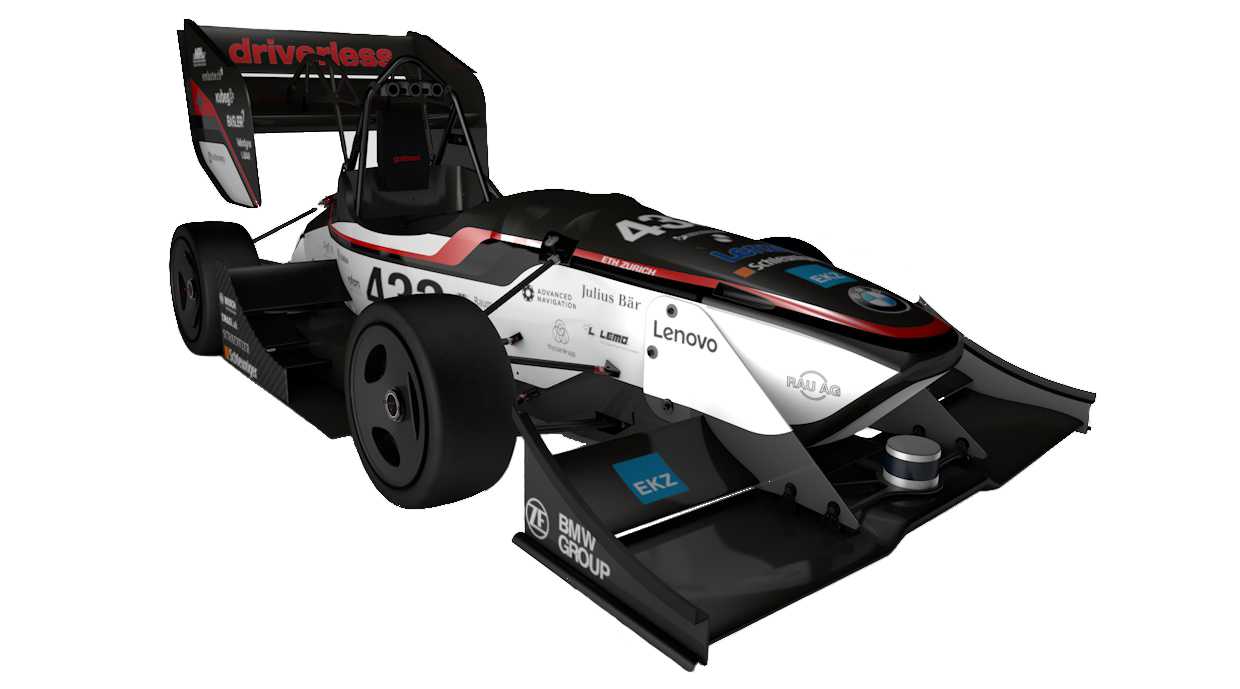
2018
Info
149x
The AMZ Racing team was founded in 2006 by students of ETH Zurich. In 2010 AMZ switched to electric vehicles and started an ongoing collaboration with the University of Lucerne. In 2017, Formula Student Driverless started and AMZ competed with two cars for the first time, electric and driverless.AMZ driverless designs and adapts previous fully autonomous formula cars. The team consists of MSc students from ETH Zürich, ranging from Robotics, Electric, Mechanical to Computer Science.
Engineering Design Priorities:
power
lightweight
efficiency
reliability
maintainability
stiffness
Car Specifications
General
| Frame Construction | CFRP monocoque |
|---|---|
| Material | CFRP pre-preg (twill and UD), aluminium honeycomb core |
| Overall L | 2943 mm |
| Overall W | 1425 mm |
| Overall H | 1159 mm |
| Wheelbase | 1530 mm |
| Track (Fr) | 1220 mm |
| Track (Rr) | 1220 mm |
| Weight with 68kg driver (Fr) | 90 kg |
| Weight with 68kg driver (Rr) | 85 kg |
| Suspension | Double unequal length A-Arms, pushrod actuated air springs and adaptive dampers, heavespri |
| Tyres (Fr / Rr) | Continental C18 13 |
| Wheels (Fr / Rr) | 7x13, 24.64 mm offset, Aluminium |
| Drive Type | Planetary-drive, with staged planets |
| Differential | - |
| Cooling | Motor and controllers water cooled, 2 aluminium cross flow radiators |
| Brake System | 4 CMC (C-SiC) floating disks, adjustable brake balance, AP racing calipers |
| Electronics | Feedback traction control, dynamic torque vectoring, multifunctional steering wheel |
Powertrain
| Number of Motors | 4 |
|---|---|
| Motor Location | On the wheel |
| Max Motor Power (per motor) | 29.4 kW kW |
| Motor Type | Permanent excited watercooled synchronous |
| Max Motor RPM (highest) | 19200 rpm |
| Motor Controller | Lenze-Schmidhauser Dual DCU |
| Max System Voltage | 470 V |
| Combined Accumulator Capacity | 2.9 kWh kWh |
| Transmission Ratio (Primary) | 1:14.4 : 1 |
Driverless System
| Processing unit(s) | PIP 39, Jetson TX2 |
|---|---|
| Floating Point Operations Per Second of all processing units that are working for the DV system | 3724 GigaFLOPS |
| Power consumption of all processing units that are working for the DV system | 120 W |
| Camera(s) | 3 cameras, 20 m range, 2 stereo 1 mono layout |
| Radar sensor(s) | - |
| Lidar sensor(s) | Velodyne Hi-Res |
| Other sensors | INS, Absolute Speed Sensor |
| Highlights of the DV system | Fully redundant sensor pipeline, robust against single sensor failure. Combined visual-LiDAR SLAM. Colour independent on-line track boundary estimation. Nonlinear Model Predictive Contouring Control |
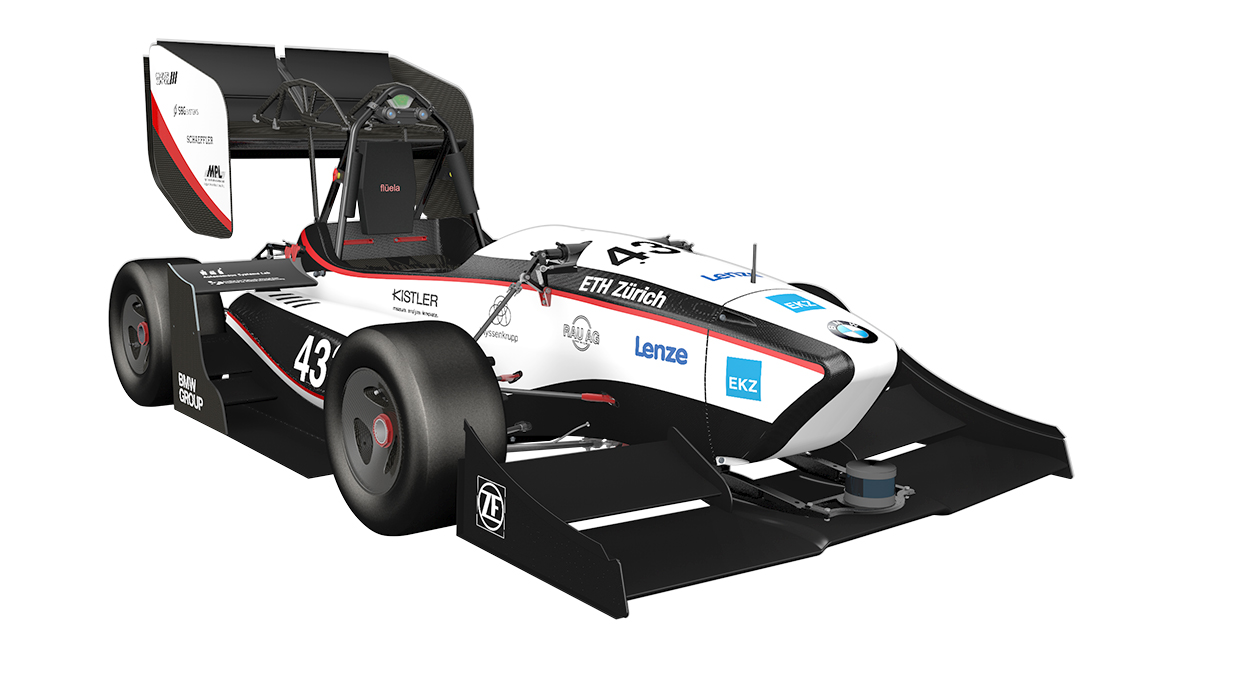
2017
Info
194x
The AMZ Racing team was founded in 2006 by students of ETH Zurich. In 2010 AMZ switched to electric vehicles and started an ongoing collaboration with the University of Lucerne. For the first time in 2017, the team enters the competition with a second vehicle: flüela driverless. Based on the 2015 car a fully autonomous vehicle is designed and tested. The team consists of former electric members as well as new students from Robotics, Systems and Controls.
Engineering Design Priorities:
powerful
lightweight
efficient
reliability
maintainability
stiffness
Car Specifications
General
| Frame Construction | CFRP single piece monocoque with integrated suspension brackets |
|---|---|
| Material | Intermediate and high modular CFRP-prepreg (twill and UD) with aluminium honeycomb core |
| Overall L | 2870 mm |
| Overall W | 1438 mm |
| Overall H | 1139 mm |
| Wheelbase | 1530 mm |
| Track (Fr) | 1200 mm |
| Track (Rr) | 1180 mm |
| Weight with 68kg driver (Fr) | 82 kg |
| Weight with 68kg driver (Rr) | 103 kg |
| Suspension | Double A-Arm Pushrod actuated by spring with custom air chamber and adaptive dampers |
| Tyres (Fr / Rr) | 465 x 191-254 Hoosier R25B (both) |
| Wheels (Fr / Rr) | 10‘‘ self developed single piece carbon rim, centerlocked (both) |
| Drive Type | planetary gear with staged planets |
| Differential | None |
| Cooling | Single serial cooling circuit with two radiators mounted in the sidepods. |
| Brake System | Self developed floating rotors, 190mm diameter, adjustable brake balance |
| Electronics | self programmed VCU and telemetry system, CAN communication via self developed mini can mo |
Powertrain
| Number of Motors | 4 |
|---|---|
| Motor Location | wheel hub mounted |
| Max Motor Power (per motor) | 4 x 37 kW kW |
| Motor Type | AMZ M5, self-developed PMSM. inrunner |
| Max Motor RPM (highest) | 20000 rpm |
| Motor Controller | Lenze Schmidhauser Dual DCU |
| Max System Voltage | 470 V |
| Electrode Materials | LiPo |
| Combined Accumulator Capacity | 6.46 kWh kWh |
| Transmission Ratio (Primary) | 1:14.5 : 1 |
| Transmission Ratio (Secondary) | - |
Driverless System
| Processing unit(s) | Robust Master and high-performance Slave |
|---|---|
| Floating Point Operations Per Second of all processing units that are working for the DV system | 368 GigaFLOPS |
| Power consumption of all processing units that are working for the DV system | 136 W |
| Camera(s) | Self-developed inertial stereo camera based on synchronized grey-scale FLIR Blackly |
| Radar sensor(s) | - |
| Lidar sensor(s) | Velodyne Puck VLP-16, mounted above the front wing |
| Other sensors | SBG Ellipse-N Inertial Navigation System, Kistler Correvit SFII Velocity Sensor |
| Highlights of the DV system | Custom computing and sensor setup, robust against single sensor failure, LiDAR SLAM, Visual-Inertial SLAM, Nonlinear Model Predictive Contouring Control, total weight of DV system: 12 kg |
FS past achievements due to World Ranking Data Base
| Date | Event | Teams | Rank | BP | CM | ED | DV SP | DV AC | AX | EN | EF | Pe | Total | Engine |
|---|---|---|---|---|---|---|---|---|---|---|---|---|---|---|
| 2026.08 | 39 |
3. |
- |
- |
1. |
2. |
2. |
1. |
8. |
- |
0.00 |
439.63 |
||
| 2026.07 | 27 |
1. |
- |
- |
1. |
2. |
1. |
2. |
1. |
- |
0.00 |
584.80 |
||
| 2025.08 | 42 |
6. |
- |
- |
1. |
5. |
1. |
5. |
11. |
- |
0.00 |
390.67 |
||
| 2025.08 | 24 |
4. |
- |
- |
3. |
1. |
4. |
- |
- |
- |
0.00 |
491.74 |
||
| 2024.08 | 27 |
1. |
- |
- |
6. |
2. |
8. |
2. |
1. |
- |
0.00 |
500.22 |
||
| 2024.08 | 13 |
1. |
6. |
1. |
1. |
4. |
3. |
3. |
4. |
- |
0.00 |
889.57 |
||
| 2023.08 | 30 |
7. |
- |
- |
2. |
4. |
- |
- |
- |
- |
0.00 |
200.70 |
||
| 2023.08 | 22 |
5. |
17. |
3. |
1. |
5. |
- |
4. |
- |
- |
0.00 |
549.52 |
||
| 2022.08 | 19 |
6. |
- |
- |
1. |
7. |
- |
- |
- |
- |
0.00 |
177.97 |
||
| 2022.08 | 22 |
5. |
3. |
11. |
3. |
5. |
- |
2. |
- |
- |
0.00 |
537.36 |
||
| 2021.08 | 17 |
3. |
5. |
2. |
2. |
2. |
- |
- |
6. |
- |
0.00 |
523.75 |
||
| 2021.08 | 12 |
4. |
3. |
7. |
3. |
- |
- |
- |
- |
- |
0.00 |
432.30 |
||
| 2019.08 | 20 |
1. |
5. |
2. |
1. |
2. |
1. |
2. |
2. |
1. |
0.00 |
933.69 |
||
| 2019.07 | 14 |
1. |
2. |
1. |
1. |
2. |
1. |
1. |
1. |
1. |
0.00 |
976.90 |
||
| 2018.08 | 17 |
1. |
5. |
3. |
1. |
1. |
4. |
- |
1. |
1. |
0.00 |
959.57 |
||
| 2018.07 | 6 |
1. |
1. |
1. |
1. |
1. |
1. |
- |
1. |
1. |
0.00 |
1000.00 |
||
| 2017.08 | 15 |
1. |
3. |
1. |
1. |
1. |
2. |
- |
1. |
1. |
0.00 |
947.09 |
||
| x 17 | ||||||||||||||