
Team Details
As of 2022, this class has been integrated into the other two classes.
Infinity Racing - Rennteam der Hochschule Kempten e.V.
| University | UAS Kempten
DE Kempten UAS short 127 |
|---|---|
| Location | Kempten, Germany |
| Homepage | https://infinityracing.de/ |
| Social Media | |
| CV Team | Infinity Racing - Rennteam der Hochschule Kempten e.V. |
| EV Team | Infinity Racing - Rennteam der Hochschule Kempten e.V |
| Short Link | tid.fsg.one/780 |
Team Description
This is the fourth year of Kempten's Infinity Racing Driverless Team.
Since the years before did not work out as hoped, we are now ready to take the competition and are full of motivation.
One of our most debilitating Challanges is to compete against the electic vehicles. If you did not know yet, we are modifing a Combustion vehicle to drive autonomous.
Not only the Electronic Throttle is something we have to implement additionally as autonomous CV, but also the energy management for all the necessary driverless systems. For example our selve-developed braking system.
Past Events
2018
Info
12x
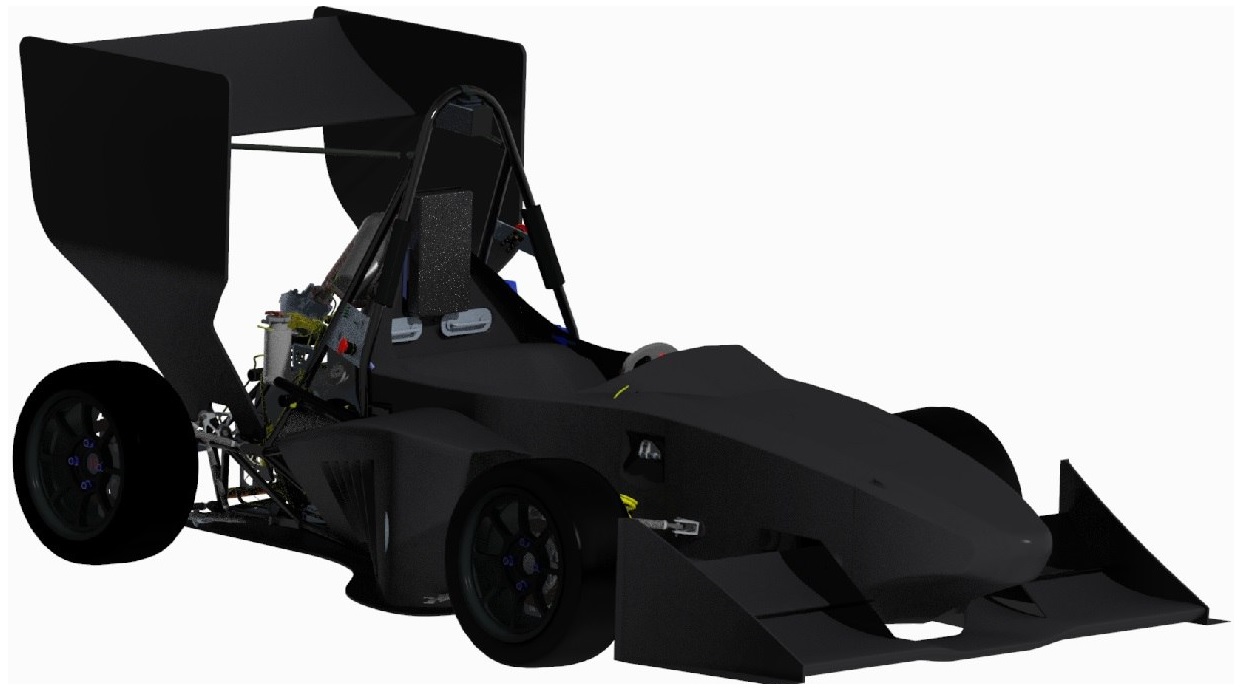
We are Infinity Racing, the Formula Student team of the University of Applied Sciences Kempten in Bavaria, Germany. The driverless team was founded in 2016. For this saison we start with fifteen passionate student and the TOMSOI VIII as base vehicle. Our main focus was to converting the combustion vehicle into an autonomous vehicle. Our core unit is a powerful embedded board TDA2X by Texas Instruments which handle with Simple and robust algorithm for mono camera and environmental model.
Engineering Design Priorities:
camera algorithm
environmental model
powerful steering
self embedded systems
electronic throttle claps
customizing of vehicle
Car Specifications
General
| Frame Construction | Hybrid Monocoque; Front: Composite Monocoque; Rear: Steel Spaceframe |
|---|---|
| Material | carbon-fibre composite; E235+C1 steel round tubing |
| Overall L | 3008 mm |
| Overall W | 1390 mm |
| Overall H | 1160 mm |
| Wheelbase | 1540 mm |
| Track (Fr) | 1220 mm |
| Track (Rr) | 1156 mm |
| Weight with 68kg driver (Fr) | 124 kg |
| Weight with 68kg driver (Rr) | 126 kg |
| Suspension | double unequal lenght A-Arms, front pullrod/ rear pushrod actuated KW spring/damper units |
| Tyres (Fr / Rr) | 205/470 R13 Continental 2016 |
| Wheels (Fr / Rr) | OZ Magnesium Rims, 7 |
| Drive Type | chain drive chain typ: Enuma 520MRD6 |
| Differential | Drexler clutch pack limited slip FS 2010,10Nm preload, 1200Nm maximum torque |
| Cooling | Twin side pod mounted radiators with thermostatic controlled electric fans |
| Brake System | 4-Disk system, 200 mm dia. Vented, adjustable brake balance |
| Electronics | wiring harness sealed to IP67, Multifunctional Steering Wheel, Electropneu. Shifting Systm |
Powertrain
| Engine | 2005 Yamaha R6 RJ 09 4 cylinder DOHC |
|---|---|
| Bore | 65.5 mm |
| Stroke | 44.5 mm |
| Cylinders | 4 |
| Displacement | 599 ccm |
| Compression Ratio | 12.4:1 : 1 |
| Fuel System | Student built ,fuel injection, sequential |
| Fuel | ROZ 98 |
| Max Power Design | 11000 rpm |
| Max Torque Design | 10000 rpm |
Driverless System
| Processing unit(s) | Texas Instruments TDA2x, Atmel 90CAN128 |
|---|---|
| Floating Point Operations Per Second of all processing units that are working for the DV system | 6.33 GigaFLOPS |
| Power consumption of all processing units that are working for the DV system | 20.00 W |
| Camera(s) | GigE, uEye, FA, 1/2“ OnSemi Python 1300 CMOS Farb Sensor, 1280x1024 Pixel, Global Shutter, Trigger-E |
| Radar sensor(s) | n/a |
| Lidar sensor(s) | n/a |
| Other sensors | Peak System PCAN-GPS, programmable sensor module, satellite receiver, magnetic field sensor, accelerometer, gyroscope, CAN |
| Highlights of the DV system | Our main focus was to converting the combustion vehicle into an autonomous vehicle. Powerful steering systems and brake system (MK100 by Continental). Embedded systems: TDA2x of Texas Instruments and Atmel 90CAN128 as Interface between Sensors and Actuators; Software development: simple and robust algorithm for the monocamera with decision tree; |