
Team Details
As of 2022, this class has been integrated into the other two classes.
TUfast Driverless
| University | Technical University of Munich
Technische Universität München local DE München TU short 12 |
 |
|---|---|---|
| Location | München, Germany | |
| Homepage | https://tufast-racingteam.de/ | |
| Social Media | ||
| CV Team | TUfast | |
| EV Team | TUfast Racing Team e-Technology | |
| Short Link | tid.fsg.one/773 | |
Past Events
2019
Info
28x
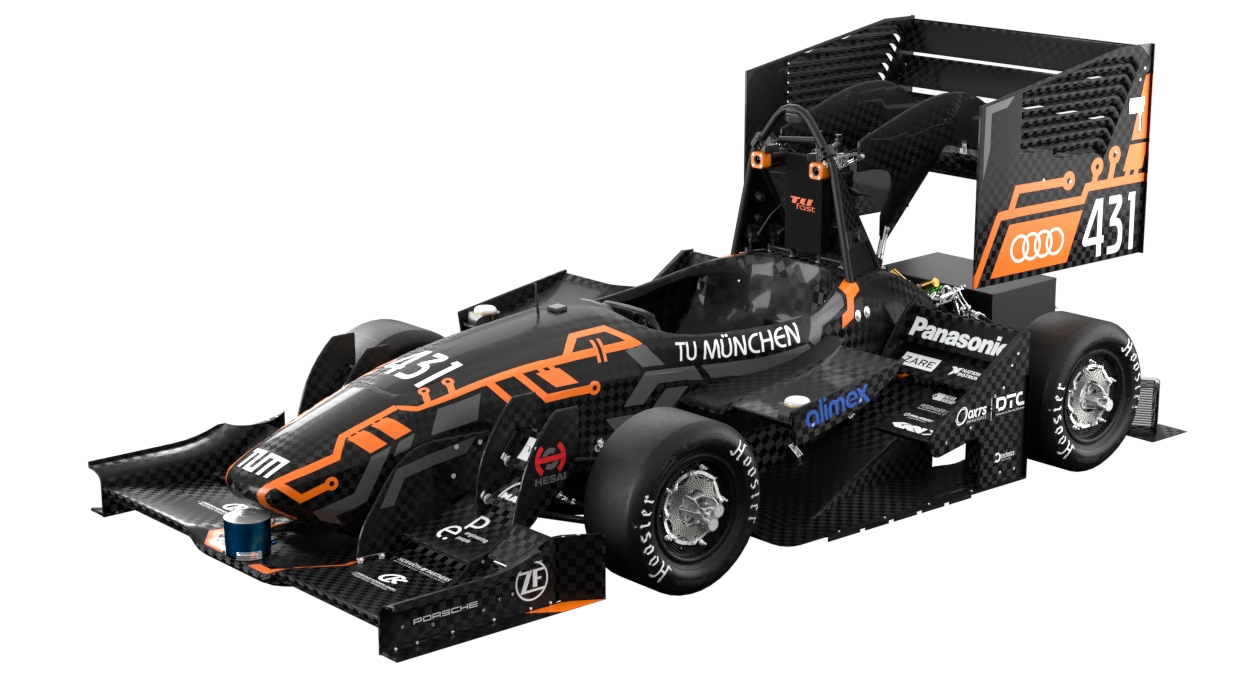
TUfast Racing Team from the TU Munich consists of 80 team members who design and build two race cars this season as a single team (electric + driverless). One Team – Two cars – TUfast. We believe our state-of-the-art planning & control, the fast and light 2017 electric car we use as the platform, the self developed perception algorithms and our agile actuation systems will contribute to our success in this season. Feel free to pay us a visit in our pit!
Engineering Design Priorities:
robust planning & control
safety and reliability
environment mapping
agile actuation
Car Specifications
General
| Frame Construction | CFRP Monocoque with aluminium honeycomb |
|---|---|
| Material | carbon fibre reinforced plastic |
| Overall L | 2933 mm |
| Overall W | 1417 mm |
| Overall H | 1176 mm |
| Wheelbase | 1550 mm |
| Track (Fr) | 1200 mm |
| Track (Rr) | 1200 mm |
| Weight with 68kg driver (Fr) | 98 kg |
| Weight with 68kg driver (Rr) | 90 kg |
| Suspension | Double unequal length A-Arm, Front: Push rod actuated, Rear: Push rod actuated |
| Tyres (Fr / Rr) | 18x6.0-10 LC0 Hoosier / 18x6.0-10 LC0 Hoosier |
| Wheels (Fr / Rr) | 6,0 x 10, 1pc: CFRP Shells / 6,0 x 10, 1pc: CFRP Shells |
| Drive Type | Planetary gearing system |
| Differential | n/a |
| Cooling | Rear mounted radiators |
| Brake System | Integrated sintered upright calipers |
| Electronics | DRS, advanced telemetry system, EMI protection |
Powertrain
| Number of Motors | 4 |
|---|---|
| Motor Location | one in each wheel |
| Max Motor Power (per motor) | 25.8 kW |
| Motor Type | Fischer TI085 |
| Max Motor RPM (highest) | 20000 rpm |
| Motor Controller | TUfast MC018 |
| Max System Voltage | 572 V |
| Electrode Materials | LiPo |
| Combined Accumulator Capacity | 7.4 kWh |
| Transmission Ratio (Primary) | 1:14.38 : 1 |
| Transmission Ratio (Secondary) | n/a : 1 |
Driverless System
| Processing unit(s) | NVIDIA Jetson AGX Xavier, Speedgoat Baseline OpenFrame, InCar PC CQ67G |
|---|---|
| Floating Point Operations Per Second of all processing units that are working for the DV system | 3548 GigaFLOPS |
| Power consumption of all processing units that are working for the DV system | 206 W |
| Camera(s) | Basler ace GigE C-Mount v01 with Stemmer CVO GMTHR24514MCN 4.5mm, IDS UI-5244LE-C-HQ-MB with 8mm Tam |
| Radar sensor(s) | n/a |
| Lidar sensor(s) | Hesai Pandar 40, 360° FOV, 40 layers |
| Other sensors | OXTS 3003 GPS, IB6 IMU, SBG GPS and IMU, Correvit SFII |
| Highlights of the DV system | Formula Student centered robust local trajectory planner,cascading non-linear feedforward controller, state-of-the-art deep learning techniques for independent cone detection on images and point clouds, robust probabilistic sensor fusion module, DSO Slam via Stereo Cameras, Extended Kalman Filter over four reliable and independent sources |
2018
Info
22x
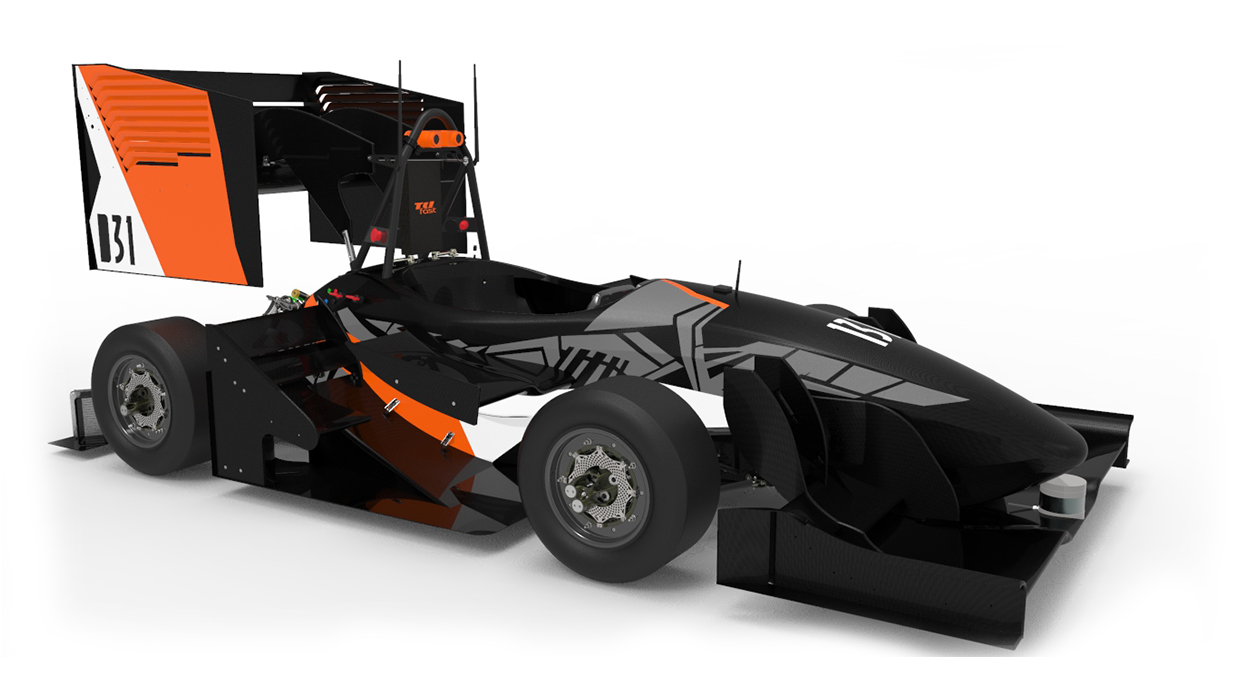
TUfast Racing Team from the TU Munich consists of 80 team members who design and build two race cars this season as a single team (electric + driverless). One Team – Two cars – TUfast. We believe our state-of-the-art verifiable trajectory planner and controller, the fast and light 2017 electric car we use as the platform, the self developed perception algorithms and our agile actuation systems will contribute to our success in this season. Feel free to pay us a visit in our pit!
Engineering Design Priorities:
verifiable trajectories
safety and reliability
environment mapping
agile actuation
Car Specifications
General
| Frame Construction | CFRP Monocoque with aluminium honeycomb |
|---|---|
| Material | carbon fibre reinforced plastic |
| Overall L | 2933 mm |
| Overall W | 1417 mm |
| Overall H | 1176 mm |
| Wheelbase | 1550 mm |
| Track (Fr) | 1200 mm |
| Track (Rr) | 1200 mm |
| Weight with 68kg driver (Fr) | 98 kg |
| Weight with 68kg driver (Rr) | 90 kg |
| Suspension | Double unequal length A-Arm, Front: Push rod actuated, Rear: Push rod actuated |
| Tyres (Fr / Rr) | 18x6.0-10 LC0 Hoosier / 18x6.0-10 LC0 Hoosier |
| Wheels (Fr / Rr) | 6,0 x 10, 1pc: CFRP Shells / 6,0 x 10, 1pc: CFRP Shells |
| Drive Type | Planetary gearing system |
| Differential | n/a |
| Cooling | Rear mounted radiators |
| Brake System | Integrated sintered upright calipers |
| Electronics | DRS, advanced telemetry system, EMI protection |
Powertrain
| Number of Motors | 4 |
|---|---|
| Motor Location | one in each wheel |
| Max Motor Power (per motor) | 27 kW |
| Motor Type | Fischer TI085 |
| Max Motor RPM (highest) | 20000 rpm |
| Motor Controller | TUfast MC018 |
| Max System Voltage | 600 V |
| Electrode Materials | LiPo |
| Combined Accumulator Capacity | 7.2kWh kWh |
| Transmission Ratio (Primary) | 1:14.38 : 1 |
| Transmission Ratio (Secondary) | n/a : 1 |
Driverless System
| Processing unit(s) | Intel Xeon |
|---|---|
| Floating Point Operations Per Second of all processing units that are working for the DV system | 756 GigaFLOPS |
| Power consumption of all processing units that are working for the DV system | 300 W |
| Camera(s) | 2 color global shutter cameras with 8mm lens |
| Radar sensor(s) | n/a |
| Lidar sensor(s) | Velodyne Ultrapuck |
| Other sensors | GPS, IMU |
| Highlights of the DV system | Trajectory guarantees, advanced photometric and laser range mapping, as well as the agile actuation systems allow us to drive quickly and reliably around the track. |
2017
Info
19x
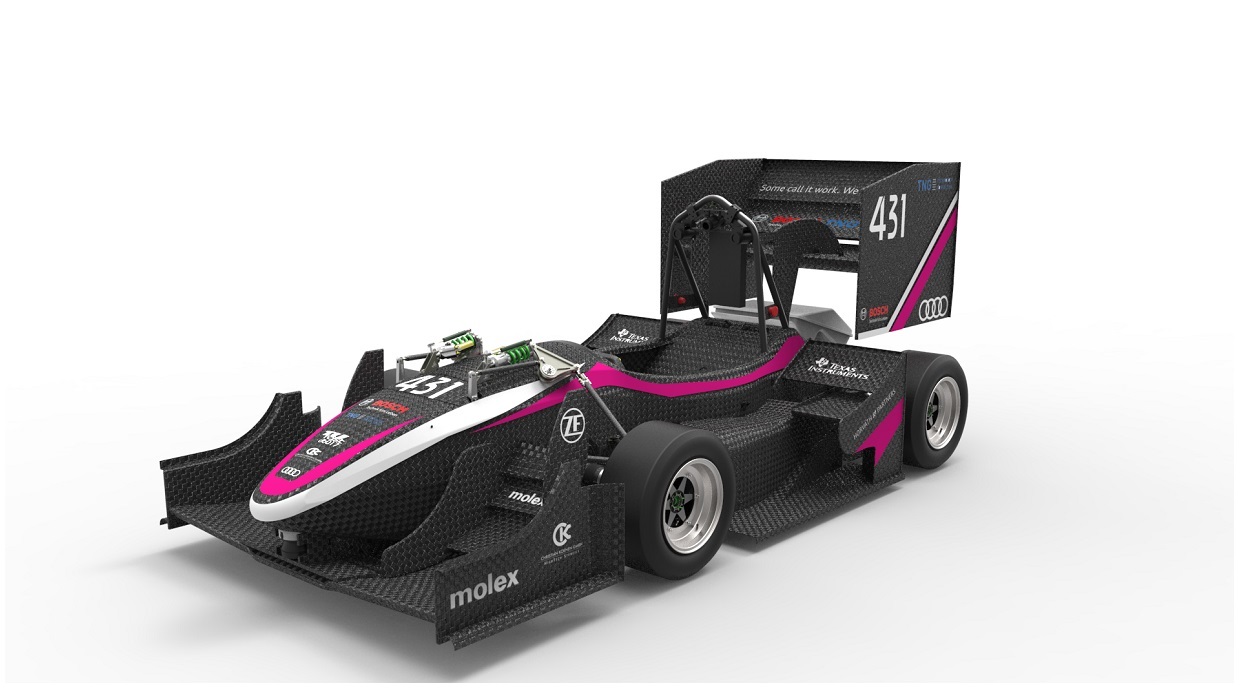
The TUfast Racing Team from TU Munich consists of 80 team members who design and build three race cars. One Team - Three Cars - TUfast. One of our main goals in designing the db017 - our self developed perception system is especially tailored to a Formula Student track. To achieve these goals, we implemented an array of sensors used for autonomous driving, tested and simulated our planning algorithms, and updated the ECU with latest TUfast software. Feel free to come to our pit and talk to us!
Engineering Design Priorities:
Environment Modelling
Vehicle Testing
Hardware Development
Autonomous driving
Car Specifications
General
| Frame Construction | CFRP Monocoque with aluminium honeycomb |
|---|---|
| Material | carbin fibre reeinforced plastic |
| Overall L | 2930 mm |
| Overall W | 1410 mm |
| Overall H | 1200 mm |
| Wheelbase | 1550 mm |
| Track (Fr) | 1200 mm |
| Track (Rr) | 1200 mm |
| Weight with 68kg driver (Fr) | 70 kg |
| Weight with 68kg driver (Rr) | 97 kg |
| Suspension | Fr/Rr Double unequal length A-Arm. Push rod actuated |
| Tyres (Fr / Rr) | 18x6.0-10 R25B Hoosier /18x6.0-10 R25B Hoosier |
| Wheels (Fr / Rr) | 7,0 x 10, 3pc: CFRP Shells, Al Center/7,0 x 10, 3pc: CFRP Shells, Al Center |
| Drive Type | two stage gearbox |
| Differential | N/A |
| Cooling | Rear mounted Radiators |
| Brake System | 4-Disk system, self developed, floating, drilled, 182x4mm, steel S355, hydraulic actuated |
| Electronics | Multifunctional Steering wheel, |
Powertrain
| Number of Motors | 4 |
|---|---|
| Motor Location | 4, mounted within Chassis |
| Max Motor Power (per motor) | 32kw kW |
| Motor Type | AMK DT5-14-10-POW |
| Max Motor RPM (highest) | FL,FR,RL,RR; 20.000 rpm |
| Motor Controller | TUfast MC015 - Team developed |
| Max System Voltage | 600V V |
| Electrode Materials | LiPO |
| Combined Accumulator Capacity | 7.67 kWh |
| Transmission Ratio (Primary) | 1:15 : 1 |
| Transmission Ratio (Secondary) | 1:15 : 1 |
Driverless System
| Processing unit(s) | Jetson TX, Vector VN8912, Arduino Due |
|---|---|
| Floating Point Operations Per Second of all processing units that are working for the DV system | 3656 GigaFLOPS |
| Power consumption of all processing units that are working for the DV system | 52 W |
| Camera(s) | 3, Range.. 0.1m - ∞/horizon, view angle 50.8° x 38.6°, BFS PGE 13Y3C-C |
| Radar sensor(s) | - |
| Lidar sensor(s) | 1, range 50m, opening angle 270deg, Sick lms151 2D Laser rangefinder |
| Highlights of the DV system | The highlight of our DV system is our perception system specifically tailored for a Formula Student track, which was tested extensively in a self developed simulation environment. Furthermore, the DV system is based on a low energy and lightwight Hardware(hw) design. This easens integration into the car and helps finding the most suitable hw setup. |
FS past achievements due to World Ranking Data Base
| Date | Event | Teams | Rank | BP | CM | ED | DV SP | DV AC | AX | EN | EF | Pe | Total | Engine |
|---|---|---|---|---|---|---|---|---|---|---|---|---|---|---|
| 2026.08 | 39 |
10. |
- |
- |
2. |
5. |
- |
9. |
- |
- |
0.00 |
224.98 |
||
| 2026.07 | 27 |
2. |
- |
- |
11. |
1. |
2. |
- |
3. |
- |
0.00 |
479.08 |
||
| 2025.08 | 42 |
4. |
- |
- |
10. |
- |
3. |
4. |
4. |
- |
0.00 |
401.33 |
||
| 2025.08 | 12 |
1. |
3. |
10. |
4. |
- |
1. |
3. |
1. |
- |
-4.00 |
818.60 |
||
| 2024.08 | 27 |
19. |
- |
- |
9. |
- |
- |
- |
- |
- |
0.00 |
105.00 |
||
| 2023.08 | 30 |
8. |
- |
- |
9. |
- |
1. |
- |
7. |
- |
0.00 |
180.00 |
||
| 2023.08 | 22 |
8. |
21. |
14. |
9. |
4. |
7. |
8. |
6. |
- |
0.00 |
451.56 |
||
| 2022.08 | 19 |
4. |
- |
- |
3. |
3. |
2. |
4. |
- |
- |
0.00 |
265.47 |
||
| 2022.08 | 22 |
9. |
9. |
10. |
4. |
- |
- |
- |
- |
- |
0.00 |
409.88 |
||
| 2019.08 | 8 |
2. |
1. |
3. |
2. |
- |
- |
- |
3. |
- |
0.00 |
402.00 |
||
| 2019.08 | 20 |
9. |
14. |
18. |
4. |
- |
- |
- |
- |
- |
-30.00 |
309.81 |
||
| 2019.07 | 14 |
4. |
7. |
6. |
3. |
- |
- |
- |
- |
- |
0.00 |
398.00 |
||
| 2018.08 | 17 |
6. |
4. |
9. |
2. |
- |
- |
- |
- |
- |
-13.00 |
366.90 |
||
| 2018.07 | 7 |
3. |
4. |
2. |
2. |
- |
- |
- |
- |
- |
0.00 |
454.80 |
||
| 2017.08 | 15 |
5. |
1. |
7. |
6. |
- |
- |
- |
- |
- |
-38.00 |
319.00 |
||
| x 15 | ||||||||||||||