
Team Details
As of 2022, this class has been integrated into the other two classes.
KA-RaceIng Driverless
| University | Karlsruhe Institute of Technology
DE Karlsruhe IT short 57 |
 |
|---|---|---|
| Location | Karlsruhe, Germany | |
| Homepage | https://www.ka-raceing.de/ | |
| Social Media | ||
| CV Team | KA-RaceIng Combustion | |
| EV Team | KA-RaceIng Electric | |
| Short Link | tid.fsg.one/786 | |
Team Description
KA-RaceIng is building two cars in the season 2021 with a team of about 75 members. We couldn't finish our cars designed in 2020. Therefore we decided to finalize the cars in 2021 and give them some smaller upgrades on the way. We focus on testing and evaluating the new concepts and designs of the KIT21d and KIT21e. We've built 13 race car with a combustion engine and the KIT21e will be our 11th car with an electric drivetrain. This year we will build a driverless car for the 5th time. The KIT21d will be built on the base of the continuously improved 2015 electric car.
Past Events
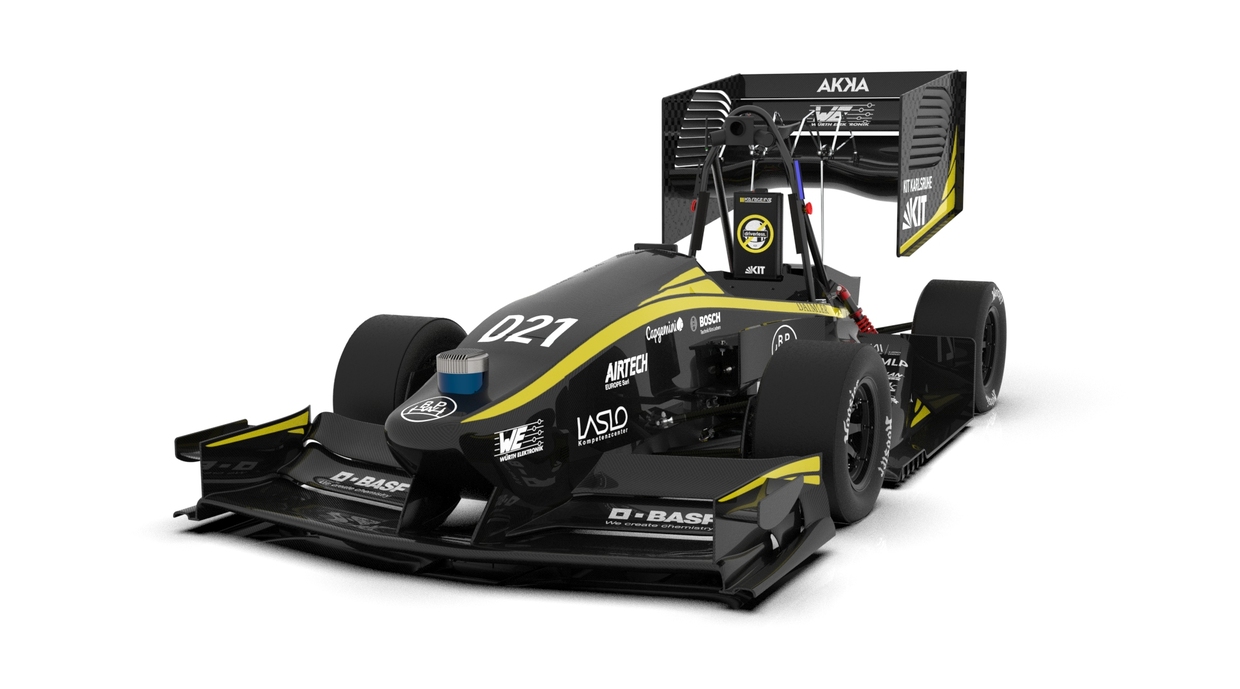
2021
Info
163x
"One team - two cars": KA-RaceIng is designing and manufacturing an FSD and FSE car in 2021, competing in both classes. In our 5th Driverless generation, we focused on developing a new aerodynamic package and reducing weight to increase the vehicle's performance. A completely new sensor setup combined with software changes increased our perception range and accuracy. New algorithms for SLAM, planning and control improved our dynamic performance significantly. See you on the race track!
Engineering Design Priorities:
oneteamtwocars
engineeredexcitement
becauseracecar
KIT
driverless
guenther
Car Specifications
General
| Frame Construction | CFRP sandwich monocoque, manufacturing method:VARI |
|---|---|
| Material | HT, IMS and HM carbon fibres, aramid twill, HM Zylon UD, Altropol Neukadur resin |
| Overall L | 2907 mm |
| Overall W | 1455 mm |
| Overall H | 1180 mm |
| Wheelbase | 1530 mm |
| Track (Fr) | 1220 mm |
| Track (Rr) | 1150 mm |
| Weight with 68kg driver (Fr) | 106 kg |
| Weight with 68kg driver (Rr) | 104 kg |
| Suspension | Double unequal length A-Arm. Pull rod actuated ZF damper with coil spring. Tight packaging |
| Tyres (Fr / Rr) | 18.0x7.5-10 Hoosier R25B |
| Wheels (Fr / Rr) | Carbon rim 7.5¨ wide |
| Drive Type | Dual - X - Drive |
| Differential | n/a |
| Cooling | Radiator cooled motor controller and 4 singel MGU cooling circuits |
| Brake System | 4 floating rotors and two piston calipers on each wheel, pneumatic actuated EBS |
| Electronics | Full customizable self-developed live telemetry, 4 Highspeed CAN 2.0 A, Baudrate: 1Mbit/s |
Powertrain
| Number of Motors | 4 |
|---|---|
| Motor Location | Front Right, Front Left |
| Max Motor Power (per motor) | 30kW kW |
| Motor Type | Self developed - KAR S02-18-30 |
| Max Motor RPM (highest) | 30000 rpm |
| Motor Controller | Aradex Ag - Typ PI 750-110×2-12V |
| Max System Voltage | 470V V |
| Electrode Materials | LiPo |
| Combined Accumulator Capacity | 5,22kWh kWh |
| Transmission Ratio (Primary) | 21 : 1 |
| Transmission Ratio (Secondary) | n/a : 1 |
Driverless System
| Processing unit(s) | Intel Core i7-9700K (8 Core) Google Coral Edge TPU coprocessor |
|---|---|
| Floating Point Operations Per Second of all processing units that are working for the DV system | 36 GigaFLOPS |
| Power consumption of all processing units that are working for the DV system | 100 W |
| Camera(s) | 2x IDS UI-3160CP Rev. 2.1 with 5mm Kowa LM5JCM + 1x Basler dart daA1600-60uc with 5.5mm Evetar |
| Radar sensor(s) | n/a |
| Lidar sensor(s) | Hesai Pandar40P |
| Other sensors | xsens IMU MTi G710, Kistler Correvit SFII ground speed sensor, Maxon EC 32 flat with Hall sensors |
| Highlights of the DV system | With a 360° LiDAR and 3 cameras, our perception system for detecting cones combines low power use with a high range of 40m and high accuracy. Even in Autocross, with parts of the map still unknown, we optimize our trajectory while driving. Our control system automatically learns from its errors and follows the given path with high precision. |
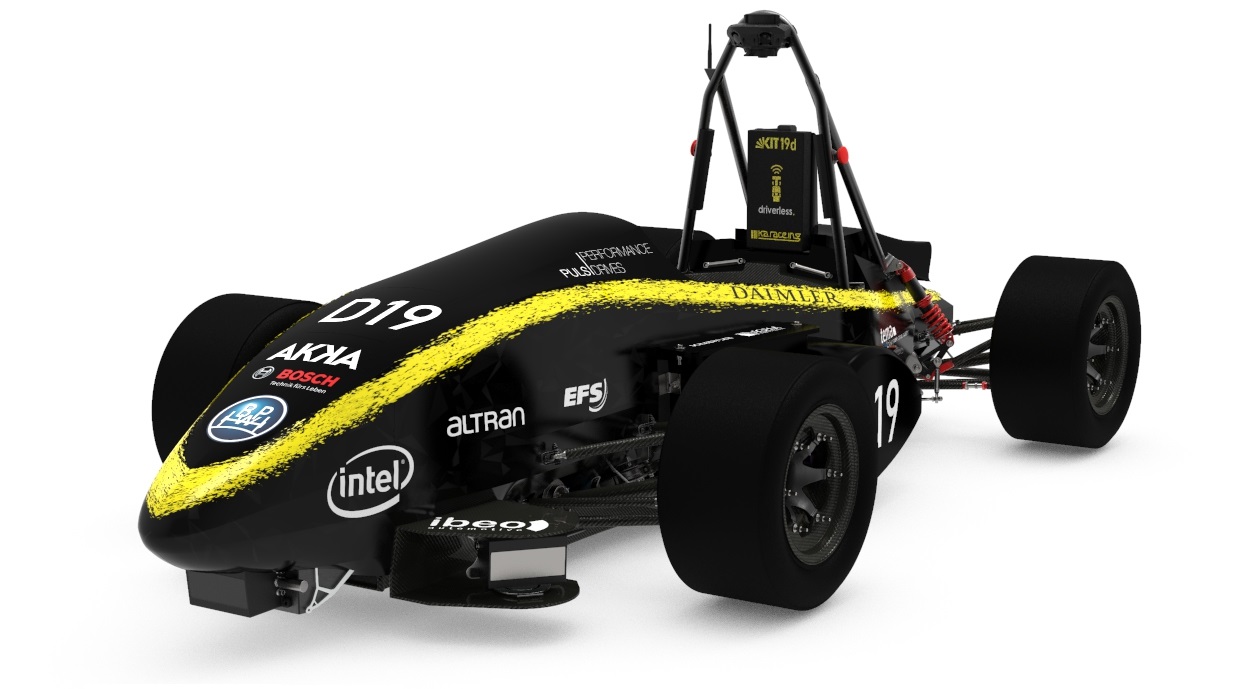
2019
Info
98x
"One team - three cars!" KA-RaceIng is designing, manufacturing and competing with a FSC, FSE and FSD car every year. With the increase in perfomance, we saw the need for aerodynamics to make further improvements in corner speed possible. The result is impressive: we threw out our sidewings. To increase our performance, we developed a model predictive control, decided to use the raw data of our LiDARs to improve the perception range by 22 meters and implemented a new, more realistic simulation.
Engineering Design Priorities:
oneteamthreecars
engineeredexcitement
mpc
aerodynamics
gameofcones
Karl
Car Specifications
General
| Frame Construction | CFRP sandwich monocoque, manufacturing method:VARI |
|---|---|
| Material | HT, IMS and HM carbon fibres, aramid twill, HM Zylon UD, Altropol Neukadur resin |
| Overall L | 2710 mm |
| Overall W | 1455 mm |
| Overall H | 1180 mm |
| Wheelbase | 1530 mm |
| Track (Fr) | 1220 mm |
| Track (Rr) | 1150 mm |
| Weight with 68kg driver (Fr) | 120 kg |
| Weight with 68kg driver (Rr) | 98 kg |
| Suspension | Double unequal length A-Arm. Pull rod actuated ZF damper with coil spring. |
| Tyres (Fr / Rr) | 18.0x6-10, Hoosier R25B |
| Wheels (Fr / Rr) | Carbon rim 7.5¨ wide |
| Drive Type | n/a |
| Differential | n/a |
| Cooling | custom oil pump in every motor |
| Brake System | 4-Disk system |
| Electronics | selfdesigned Live-Telemetry System |
Powertrain
| Number of Motors | 4 |
|---|---|
| Motor Location | front and rear central |
| Max Motor Power (per motor) | 23kW kW |
| Motor Type | KAR S02-18-30 |
| Max Motor RPM (highest) | 30000 rpm |
| Motor Controller | Aradex Ag - Typ PI 750-110×2-12V |
| Max System Voltage | 470 V |
| Electrode Materials | Lithium Polymer |
| Combined Accumulator Capacity | 5,221kWh kWh |
| Transmission Ratio (Primary) | n/a : 1 |
| Transmission Ratio (Secondary) | n/a : 1 |
Driverless System
| Processing unit(s) | Mini itx Mainboard + Graphics Card |
|---|---|
| Floating Point Operations Per Second of all processing units that are working for the DV system | n/a GigaFLOPS |
| Power consumption of all processing units that are working for the DV system | 200 W |
| Camera(s) | 2 Basler dart cameras looking forward/to the side and one Basler dart camera looking back |
| Radar sensor(s) | n/a |
| Lidar sensor(s) | Four ibeo LUX 2010 with an opening angle of 110° |
| Other sensors | xsens IMU MTi G710 |
| Highlights of the DV system | The Highlights of our DV system are a high ranged cone detection at 25Hz using LiDAR detections to determine interesting areas in the image planes. In addition, a self developed simulation is used to improve our modelbased trajectory planning and control algorithms. |
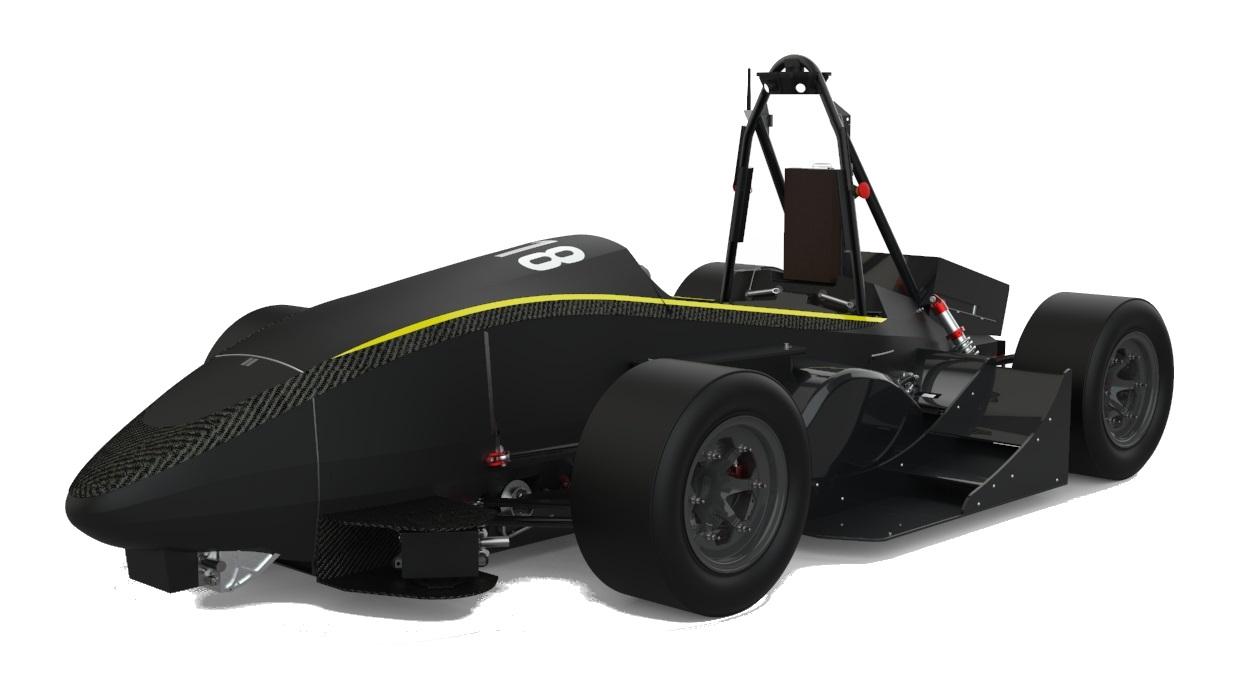
2018
Info
73x
KA-RaceIng is the Formula Student team of the Karlsruhe Institute of Technology, founded in 2006. Since 2010 we are designing, manufacturing and competing with a FSC and FSE car each year and since last year also with a driverless car for the FSD. The KIT18d is KA-RaceIng's secound fully autnomous racecar and is based our the KIT15e. We would like to thank all our supporters for the enormous help throughout the season!
Engineering Design Priorities:
karaceing
becauseracecar
driverless
KIT18d
KIT
roborace
Car Specifications
General
| Frame Construction | CFRP sandwich monocoque |
|---|---|
| Material | HT and HM fibres, twill and unidirectional plies, kevlar twill |
| Overall L | 2710 mm |
| Overall W | 1455 mm |
| Overall H | 1040 mm |
| Wheelbase | 1530 mm |
| Track (Fr) | 1220 mm |
| Track (Rr) | 1150 mm |
| Weight with 68kg driver (Fr) | 120 kg |
| Weight with 68kg driver (Rr) | 98 kg |
| Suspension | Double unequal length A-Arm. Pull rod actuated damper with coil spring. |
| Tyres (Fr / Rr) | Hoosier R25B 18.0x7.5-10 / Hoosier R25B 18.0x7.5-10 |
| Wheels (Fr / Rr) | CFRP rim 7.5 |
| Cooling | Three Radiators, Motor controllers water cooled, seperate oil cooling circuit per motor |
| Brake System | 4 floating disks and two piston calipers on each wheel |
| Electronics | Live-Telemetry, Traction Control, Torque Vectoring, modular hardware design |
Powertrain
| Number of Motors | 4 |
|---|---|
| Motor Location | Mounted on the chassis |
| Max Motor Power (per motor) | 23kW kW |
| Motor Type | internal permanent magnet synchronous motor |
| Max Motor RPM (highest) | 30.000 rpm |
| Motor Controller | Aradex Vectopower |
| Max System Voltage | 470V V |
| Electrode Materials | Lithium-Polymer |
| Combined Accumulator Capacity | 5.2 kWh kWh |
Driverless System
| Processing unit(s) | nvidia gtx 1060, intel i7-6700, self designed main control unit |
|---|---|
| Floating Point Operations Per Second of all processing units that are working for the DV system | 4700 GigaFLOPS |
| Power consumption of all processing units that are working for the DV system | 80 W |
| Camera(s) | 2 Basler dart cameras looking forward/to the side and one Basler dart camera looking back |
| Lidar sensor(s) | 4 ibeo LUX 2010 with a total opening angle of 160° |
| Other sensors | xsens IMU Mit G710; novatel PwrPak 7D-E1 |
| Highlights of the DV system | Completely redundandt camera and lidar system, simulation of the whole AS, ability to drive locally but also to create a map and calculate global trajectory, vehicle is optimized for lidar and camera perception |
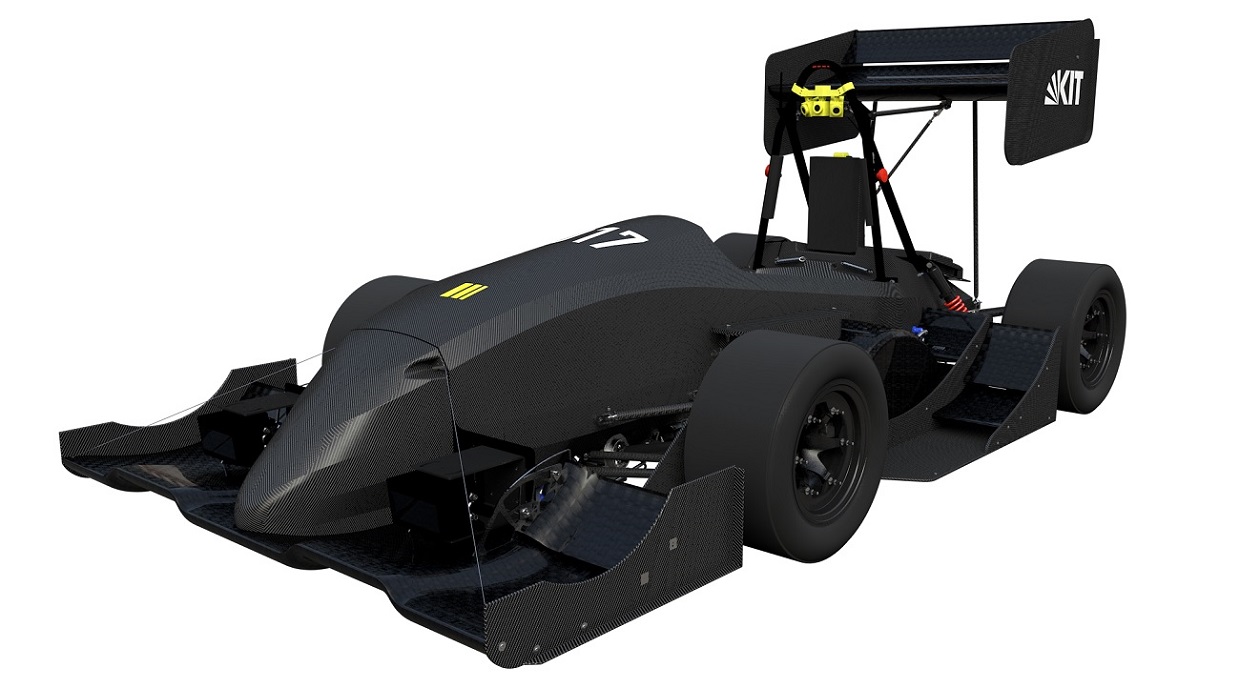
2017
Info
74x
KA-RaceIng is the Formula Student team of the Karlsruhe Institute of Technology, founded in 2006. Since 2010 we are designing, manufacturing and competing with a FSC and FSE car each year and since this year also with a driverless car for the FSD. The KIT17d is KA-RaceIng's first fully autnomous racecar and is based our the KIT15e. We would like to thank all our supporters for the enormous help throughout the season!
Engineering Design Priorities:
KIT
driverless
reliability
dual-x-drive
Karlsruhe
Car Specifications
General
| Frame Construction | CFRP sandwich monocoque, motor-gear-units mounted underneath |
|---|---|
| Material | HT and HM fibres, twill and unidirectional plies, kevlar twill |
| Overall L | 2907 mm |
| Overall W | 1455 mm |
| Overall H | 1566 mm |
| Wheelbase | 1530 mm |
| Track (Fr) | 1220 mm |
| Track (Rr) | 1150 mm |
| Weight with 68kg driver (Fr) | 120 kg |
| Weight with 68kg driver (Rr) | 98 kg |
| Suspension | Double unequal length A-Arm. Pull rod actuated KAZ damper with coil spring |
| Tyres (Fr / Rr) | Hoosier 18.0x7.5-10 R25B |
| Wheels (Fr / Rr) | Hoosier 18.0x7.5-10 R25B |
| Cooling | Three Radiators, Motor controllers water cooled, seperate oil cooling circuit per motor |
| Brake System | 4 floating disks and two piston calipers on each wheel |
| Electronics | Live-Telemetry, Traction Control, Torque Vectoring, modular hardware design |
Powertrain
| Number of Motors | 4 |
|---|---|
| Motor Location | Mounted on the chassis |
| Max Motor Power (per motor) | 23kW kW |
| Motor Type | internal permanent magnet synchronous motor |
| Max Motor RPM (highest) | 30.000 rpm |
| Motor Controller | Aradex Vectopower |
| Max System Voltage | 588V V |
| Electrode Materials | Lithium-Polymer |
| Combined Accumulator Capacity | 6.5kWh kWh |
| Transmission Ratio (Primary) | 1:21 : 1 |
Driverless System
| Processing unit(s) | Nvidia Drive PX 2 and existing Main Control Unit in car |
|---|---|
| Floating Point Operations Per Second of all processing units that are working for the DV system | 16000 GigaFLOPS |
| Power consumption of all processing units that are working for the DV system | 150 W |
| Camera(s) | one forward looking with 60° opening angle; two side looking with 100° |
| Radar sensor(s) | N/A |
| Lidar sensor(s) | two Ibeo LUX; combined opening angle of 160° at angular resolution of 0.25° |
| Other sensors | Tightly Coupled GPS/INS |
| Highlights of the DV system | - fully redundant emergency brake system - cone detection with Deep Neuronal Network - completely self developped framework - Software in the Loop simulation with IPG Carmaker - self-developed interface to IPG carmaker |
FS past achievements due to World Ranking Data Base
| Date | Event | Teams | Rank | BP | CM | ED | DV SP | DV AC | AX | EN | EF | Pe | Total | Engine |
|---|---|---|---|---|---|---|---|---|---|---|---|---|---|---|
| 2026.08 | 39 |
6. |
- |
- |
4. |
1. |
1. |
4. |
- |
- |
-25.00 |
318.32 |
||
| 2026.07 | 27 |
4. |
- |
- |
8. |
3. |
3. |
3. |
4. |
- |
-25.00 |
435.92 |
||
| 2025.08 | 42 |
2. |
- |
- |
3. |
4. |
8. |
1. |
1. |
- |
-10.00 |
547.47 |
||
| 2025.08 | 24 |
3. |
- |
- |
7. |
2. |
5. |
1. |
- |
- |
0.00 |
631.47 |
||
| 2024.08 | 27 |
5. |
- |
- |
1. |
3. |
2. |
6. |
10. |
- |
0.00 |
354.32 |
||
| 2024.08 | 13 |
2. |
12. |
9. |
2. |
1. |
1. |
4. |
3. |
- |
0.00 |
859.02 |
||
| 2023.08 | 30 |
2. |
- |
- |
1. |
1. |
2. |
- |
6. |
- |
0.00 |
304.05 |
||
| 2023.08 | 22 |
4. |
8. |
4. |
3. |
- |
8. |
- |
4. |
1. |
0.00 |
660.71 |
||
| 2022.08 | 22 |
1. |
7. |
2. |
2. |
1. |
3. |
1. |
1. |
2. |
0.00 |
956.27 |
||
| 2022.07 | 5 |
2. |
2. |
1. |
1. |
1. |
2. |
- |
2. |
- |
0.00 |
560.57 |
||
| 2021.08 | 17 |
1. |
6. |
4. |
1. |
1. |
3. |
2. |
2. |
1. |
-5.00 |
870.15 |
||
| 2021.08 | 12 |
1. |
6. |
1. |
2. |
1. |
2. |
2. |
2. |
2. |
0.00 |
759.60 |
||
| 2021.08 | 5 |
1. |
1. |
2. |
1. |
1. |
1. |
- |
1. |
1. |
0.00 |
874.00 |
||
| 2019.08 | 8 |
1. |
5. |
7. |
1. |
1. |
1. |
1. |
1. |
1. |
0.00 |
925.00 |
||
| 2019.08 | 20 |
2. |
9. |
8. |
2. |
1. |
- |
1. |
1. |
2. |
-5.00 |
864.68 |
||
| 2019.07 | 14 |
6. |
6. |
9. |
4. |
- |
- |
- |
- |
- |
0.00 |
394.70 |
||
| 2018.08 | 17 |
2. |
1. |
6. |
2. |
2. |
3. |
- |
4. |
- |
-25.00 |
522.07 |
||
| 2018.07 | 7 |
1. |
3. |
3. |
3. |
1. |
1. |
- |
- |
- |
0.00 |
586.10 |
||
| 2018.07 | 6 |
3. |
3. |
2. |
3. |
- |
2. |
- |
3. |
- |
-100.00 |
443.58 |
||
| 2017.08 | 15 |
2. |
2. |
2. |
4. |
3. |
1. |
- |
- |
- |
0.00 |
463.50 |
||
| x 20 | ||||||||||||||