
Team Details
As of 2022, this class has been integrated into the other two classes.
Schanzer Racing Electric
| University | Technische Hochschule Ingolstadt
DE Ingolstadt UAS short 686 |
|---|---|
| Location | Ingolstadt, Germany |
| Homepage | https://schanzer-racing.de/ |
| EV Team | Schanzer Racing Electric e.V. |
| Short Link | tid.fsg.one/794 |
Past Events
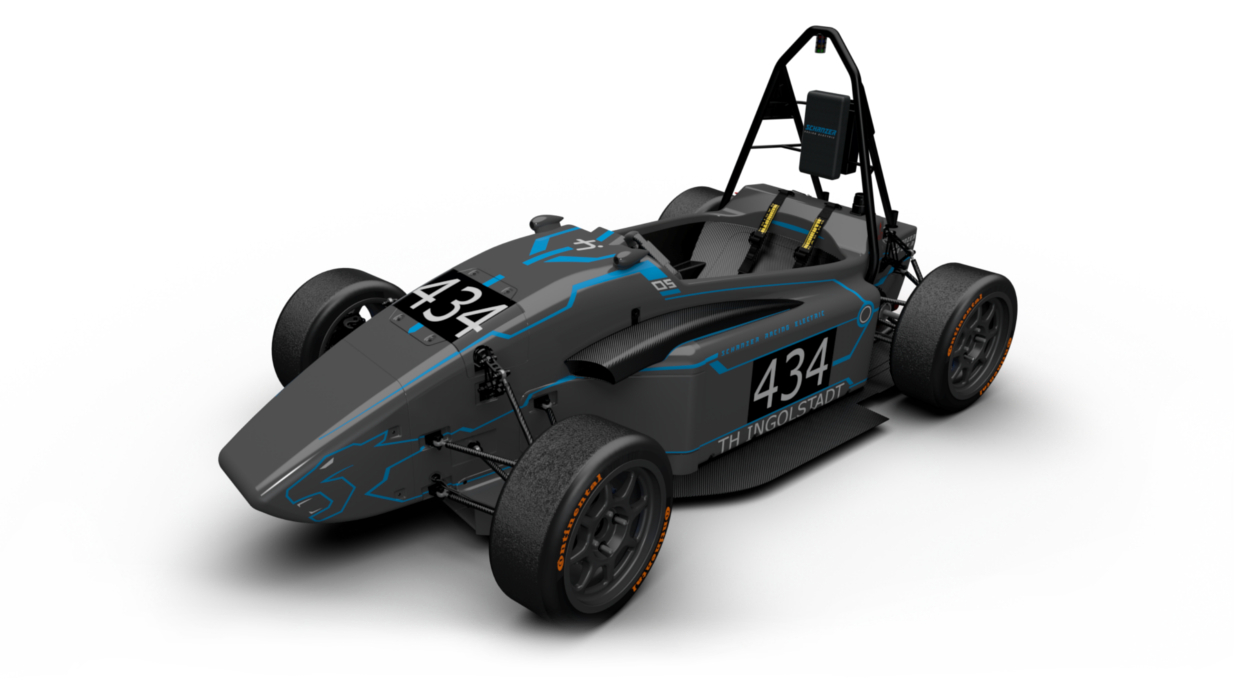
2017
Info
14x
Of course Schanzer Racing electric wasn't able to hide from the new challenges introduced by the new Driverless Class of FSG and the advancements in the automotive industry.The Driverless Division is the new department of Schanzer Racing electric, which consists of 21 team members with a focus on computer science skills. Most team members were recruited new, but we also have veterans from the last seasons.Based on our 2016 car we were able to build our driverless car on a solid foundation.
Engineering Design Priorities:
#HastAAusbildung?
#CamerasOnly
#AI
#SchanzerOnTrack
#maxedHumanWeightSaving
#WingsAreForFlying
Car Specifications
General
| Frame Construction | CFRP Monocoque |
|---|---|
| Material | Carbon Fibre Reinforced Plastic |
| Overall L | 2449 mm |
| Overall W | 1436 mm |
| Overall H | 1134 mm |
| Wheelbase | 1550 mm |
| Track (Fr) | 1214 mm |
| Track (Rr) | 1176 mm |
| Suspension | Double equal length A-Arm, Push rod actuating horizontal oriented spring-damper |
| Tyres (Fr / Rr) | 205/470 R13 |
| Wheels (Fr / Rr) | 10x0x6.0 Magnesium OZ |
| Differential | Torque vectoring |
| Cooling | Rear mounted, one radiator with two 25w pumps |
| Brake System | 4-Disk system, self developed rotors with 195mm diameter, adjustable brake balance |
| Electronics | one-way Live-Telemetry, DV-System, distributed I/O-Node system |
Powertrain
| Number of Motors | 2 |
|---|---|
| Motor Location | rear right, rear left |
| Max Motor Power (per motor) | 80kW, 80kW kW |
| Motor Type | Enstroj Ermaß 207 |
| Max Motor RPM (highest) | Rl, RR: 7000 rpm |
| Motor Controller | Infineon Hybrid Kit 1 (Pin Fin) |
| Max System Voltage | 420V V |
| Electrode Materials | LiNiCoAlO2 |
| Combined Accumulator Capacity | 7,2kWh kWh |
| Transmission Ratio (Primary) | 1:4,36 : 1 |
| Transmission Ratio (Secondary) | N/A : 1 |
Driverless System
| Processing unit(s) | NVIDIA DRIVE PX2 |
|---|---|
| Power consumption of all processing units that are working for the DV system | 250 W |
| Camera(s) | 2x 60° >150m front facing, 2x 100° rear facing |
| Other sensors | 1x dGPS |
| Highlights of the DV system | Our Highlights are the two rear-facing cameras that are used - amongst other things - to evaluate the driven lane. We also feature a high definition mapping approach as a base for our trajectory calculations. |
FS past achievements due to World Ranking Data Base
| Date | Event | Teams | Rank | BP | CM | ED | DV SP | DV AC | AX | EN | EF | Pe | Total | Engine |
|---|---|---|---|---|---|---|---|---|---|---|---|---|---|---|
| 2026.08 | 15 |
4. |
- |
- |
1. |
- |
- |
- |
- |
- |
0.00 |
140.00 |
||
| 2026.08 | 39 |
33. |
- |
- |
29. |
- |
- |
- |
- |
- |
-20.00 |
50.00 |
||
| 2025.09 | 8 |
7. |
3. |
7. |
7. |
- |
- |
3. |
- |
- |
0.00 |
283.18 |
||
| 2025.08 | 24 |
15. |
- |
- |
14. |
- |
- |
- |
- |
- |
0.00 |
206.90 |
||
| 2024.08 | 12 |
12. |
- |
- |
- |
- |
- |
- |
- |
- |
0.00 |
0.00 |
||
| 2017.08 | 15 |
14. |
15. |
12. |
15. |
- |
- |
- |
- |
- |
-36.00 |
142.21 |
||
| x 6 | ||||||||||||||