
Team Details
As of 2022, this class has been integrated into the other two classes.
GreenTeam Driverless Uni Stuttgart
| University | Universität Stuttgart
DE Stuttgart U short 21 |
|---|---|
| Location | Stuttgart, Germany |
| Homepage | https://www.greenteam-stuttgart.de/ |
| Social Media | |
| CV Team | Rennteam Uni Stuttgart |
| EV Team | Rennteam Uni Stuttgart |
| Short Link | tid.fsg.one/782 |
Past Events
2021
Info
74x
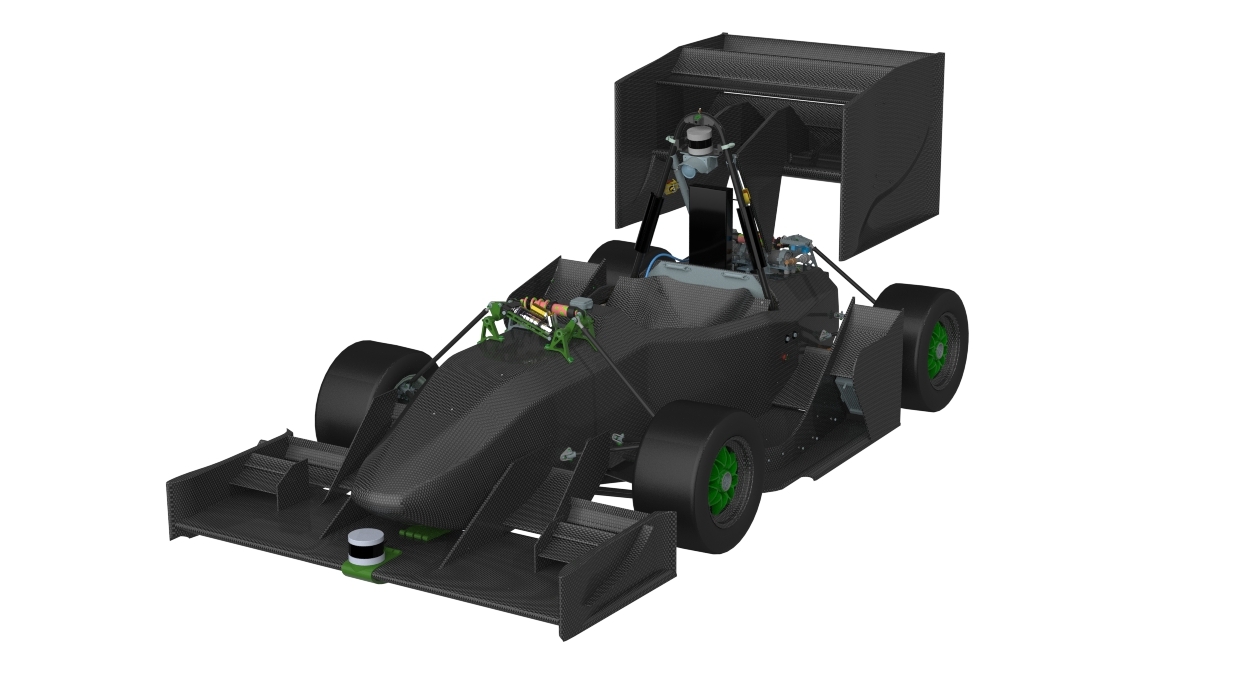
2021 marks the 12th anniversary of the GreenTeam and the 4rd time we participate at Hockenheim with our driverless car. Within the last eight months this team has transformed the previous year’s vehicle, the D0711-3, to a more performant autonomous vehicle, the D0711-4. One camera and one LiDAR, EKF SLAM and a stanley control enable our car to excel on the track.
Engineering Design Priorities:
Development Speed
Reliability
Validation
Performance
Accuracy
Redundancy
Car Specifications
General
| Frame Construction | Carbon fiber sandwich structure monocoque |
|---|---|
| Material | Aluminium honeycomb sandwich panel |
| Overall L | 3000 mm |
| Overall W | 1440 mm |
| Overall H | 1200 mm |
| Wheelbase | 1540 mm |
| Track (Fr) | 1200 mm |
| Track (Rr) | 1200 mm |
| Weight with 68kg driver (Fr) | 80 kg |
| Weight with 68kg driver (Rr) | 85 kg |
| Suspension | Double A-Arm, heave/roll spring-damper-system |
| Tyres (Fr / Rr) | Hoosier R25B 18x7.5 - 10 |
| Wheels (Fr / Rr) | 8.0 wide 2 pc Hybrid (Al, CFRP) |
| Drive Type | Planetary gearbox |
| Cooling | Water-cooling, radiators in front of rear-wheels |
| Brake System | 4-Disk system, self developed steel brake disk |
| Electronics | Self-designed system electronics, wireless CAN and live video feed |
Powertrain
| Number of Motors | 4 |
|---|---|
| Motor Location | One at each Wheel |
| Max Motor Power (per motor) | 32.5 kW per Motor kW |
| Motor Type | AMK DT5-14-10-POW |
| Max Motor RPM (highest) | 20000 rpm |
| Motor Controller | AMK KW26-S5-FSE-4Q |
| Max System Voltage | 504 V |
| Electrode Materials | LiPo |
| Combined Accumulator Capacity | 3.2kWh kWh |
| Transmission Ratio (Primary) | 1:13.5 : 1 |
| Transmission Ratio (Secondary) | - |
Driverless System
| Processing unit(s) | Speegoat Baseline as Vehicle Dynamics ECU, Vecow EVS1100 as Autonomous System ECU |
|---|---|
| Floating Point Operations Per Second of all processing units that are working for the DV system | 6000 GigaFLOPS |
| Power consumption of all processing units that are working for the DV system | 610.00 W |
| Camera(s) | Matrix Vision mvBlueFox 2089-aC |
| Lidar sensor(s) | Ouster OS1 |
| Highlights of the DV system | Sensor concept consisting of one camera and one LiDAR, EKF-SLAM, Model Predictive Control |
2019
Info
24x
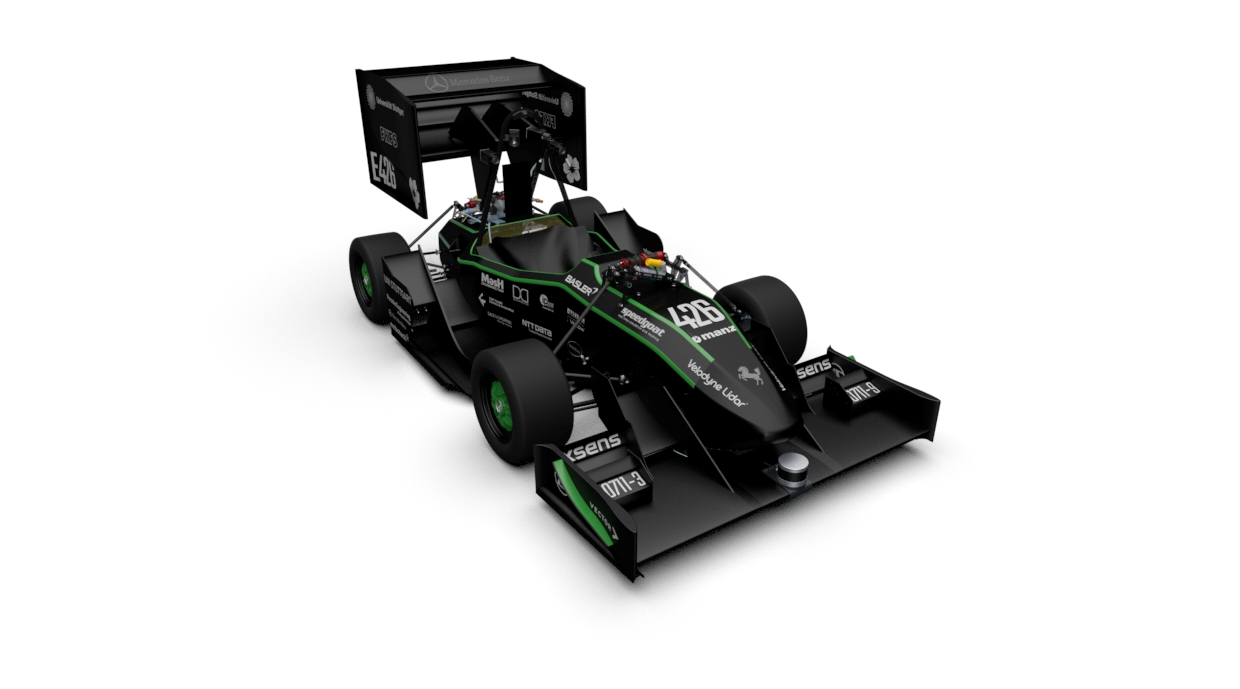
2019 marks the 10th anniversary of the GreenTeam and the 3rd time we partipate at Hockenheim with our driverless car. At the beginning of the season, the driverless project was – after two years of development - fully integrated into the team. Within the last eight months this team has transformed the previous year’s vehicle, the E0711-9, to a fully autonomous vehicle, the D0711-3. Four cameras and one LiDAR, Visual-Graph SLAM and a pure pursuit control enable our car to excel on the track.
Engineering Design Priorities:
Development Speed
Redundancy
Validation
Performance
Reliability
Accuracy
Car Specifications
General
| Frame Construction | Carbon fiber sandwich structure monocoque |
|---|---|
| Material | Aluminium honeycomb sandwich panel |
| Overall L | 3000 mm |
| Overall W | 1440 mm |
| Overall H | 1200 mm |
| Wheelbase | 1540 mm |
| Track (Fr) | 1200 mm |
| Track (Rr) | 1200 mm |
| Weight with 68kg driver (Fr) | 80 kg |
| Weight with 68kg driver (Rr) | 85 kg |
| Suspension | Double A-Arm, heave/roll spring-damper-system |
| Tyres (Fr / Rr) | Hoosier R25B 18x7.5 - 10 |
| Wheels (Fr / Rr) | 8.0 wide 2 pc Hybrid (Al, CFRP) |
| Drive Type | Planetary gearbox |
| Cooling | Water-cooling, radiators in front of rear-wheels |
| Brake System | 4-Disk system, self developed steel brake disk |
| Electronics | Self-designed system electronics, wireless CAN and live video feed |
Powertrain
| Number of Motors | 4 |
|---|---|
| Motor Location | One at each Wheel |
| Max Motor Power (per motor) | 32.5 kW per Motor kW |
| Motor Type | AMK DT5-14-10-POW |
| Max Motor RPM (highest) | 20000 rpm |
| Motor Controller | AMK KW26-S5-FSE-4Q |
| Max System Voltage | 504 V |
| Electrode Materials | LiPo |
| Combined Accumulator Capacity | 3.2kWh kWh |
| Transmission Ratio (Primary) | 1:13.5 : 1 |
| Transmission Ratio (Secondary) | - |
Driverless System
| Processing unit(s) | Speegoat Baseline as Vehicle Dynamics ECU, Vecow EVS1100 as Autonomous System ECU |
|---|---|
| Floating Point Operations Per Second of all processing units that are working for the DV system | 6000 GigaFLOPS |
| Power consumption of all processing units that are working for the DV system | 610.00 W |
| Camera(s) | Basler acA1920(2x), Basler acA1300(2x) |
| Lidar sensor(s) | Velodyne VLP16 Hi-Res |
| Highlights of the DV system | Sensor concept consisting of four cameras (2x Mono, 1x Stereo Setup), FPGA accelerated image processing, Semi-Global-Matching, Visual-Graph SLAM, Model Predictive Control |
2017
Info
19x
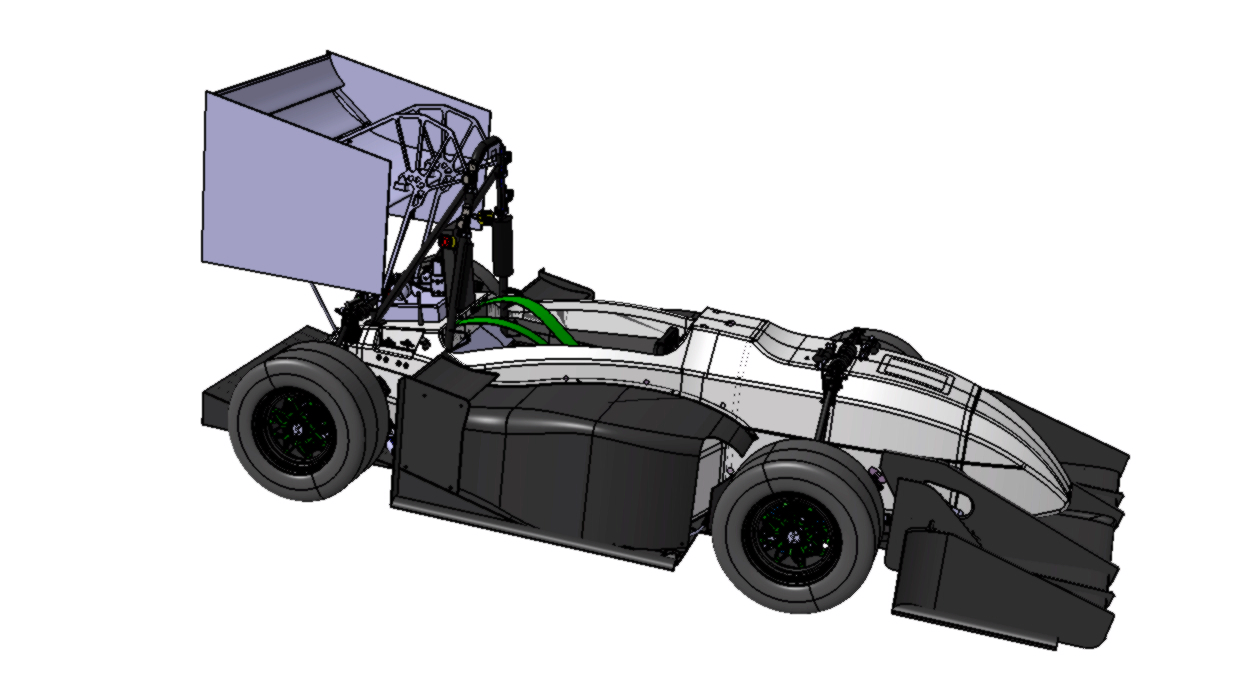
May we present: The E7000, the driverless racecar based on the last years E0711-7. Our 22 team members aimed for not to crash the car while trying to drive autonomously. This has been achieved by the extensive use of Overengineering, gaffer and by colleagues asking questions like 'is the weight important without a driver?' The overwhelming result: A nonetheless amazing autonomous car full of intended and unintended special features, a year full of work and fun.
Engineering Design Priorities:
#dontcrash
#knightrider
#KITTcomegetme
#feuerfrei
#greenandsexy
#förderverein
Car Specifications
General
| Frame Construction | one-piece monocoque with tubular steel main roll hoop and aluminium fr-roll hoop |
|---|---|
| Material | CFRP and aluminium honeycomb sandwich |
| Overall L | 2925 mm |
| Overall W | 1399 mm |
| Overall H | 1200 mm |
| Wheelbase | 1560 mm |
| Track (Fr) | 1160 mm |
| Track (Rr) | 1160 mm |
| Weight with 68kg driver (Fr) | 100 kg |
| Weight with 68kg driver (Rr) | 110 kg |
| Suspension | Double unequal length A-Arm. Push rod actuated mono spring with U-ARB |
| Tyres (Fr / Rr) | 18.0x7.5 R10, Hoosier R25B |
| Wheels (Fr / Rr) | 10x8.0, 2pc CFRP-Aluminium wheels |
| Drive Type | 2-stage planetary gearbox |
| Differential | electronic torque vectoring |
| Cooling | sidepod mounted radiators for motors, inverters and accumulator |
| Brake System | self-developed rotors and adjustable pedalbox, adjustable brake balance |
| Electronics | self-designed system electronics, wireless CAN and live video feed, model based control |
Powertrain
| Number of Motors | 4 |
|---|---|
| Motor Location | wheel carriers |
| Max Motor Power (per motor) | 34 kW |
| Motor Type | PESM AMK, DT5, 14-10-POW |
| Max Motor RPM (highest) | 20.000 rpm |
| Motor Controller | AMK KW26-S5-FSE-4Q |
| Max System Voltage | 595 V |
| Electrode Materials | LiCoO2 |
| Combined Accumulator Capacity | 6.8kWh kWh |
| Transmission Ratio (Primary) | 13.5:1 : 1 |
| Transmission Ratio (Secondary) | n/a : 1 |
Driverless System
| Processing unit(s) | NVIDIA Drive PX2 |
|---|---|
| Floating Point Operations Per Second of all processing units that are working for the DV system | 8000 GigaFLOPS |
| Power consumption of all processing units that are working for the DV system | 200 W |
| Camera(s) | 2 cameras for 30m range and 60° as a stereo pair. 2 cameras ->10m range and 110° range |
| Radar sensor(s) | n/a |
| Lidar sensor(s) | n/a |
| Other sensors | n/a |
| Highlights of the DV system | Staying within the track limits and minimizing the lap time are our main goals. In order to achieve this we focused the concept of the autonomous systm to build a car that is just limited by the physical boundaries and not by the Driver. |
FS past achievements due to World Ranking Data Base
| Date | Event | Teams | Rank | BP | CM | ED | DV SP | DV AC | AX | EN | EF | Pe | Total | Engine |
|---|---|---|---|---|---|---|---|---|---|---|---|---|---|---|
| 2026.07 | 27 |
26. |
- |
- |
27. |
- |
- |
- |
- |
- |
-25.00 |
55.80 |
||
| 2025.08 | 12 |
5. |
10. |
6. |
3. |
1. |
4. |
- |
- |
- |
0.00 |
398.80 |
||
| 2023.08 | 30 |
10. |
- |
- |
5. |
- |
3. |
- |
- |
- |
0.00 |
167.76 |
||
| 2023.08 | 22 |
16. |
4. |
13. |
10. |
- |
- |
- |
- |
- |
-60.00 |
306.31 |
||
| 2021.08 | 17 |
8. |
2. |
3. |
6. |
- |
- |
- |
- |
- |
-18.00 |
314.00 |
||
| 2021.08 | 12 |
7. |
4. |
2. |
5. |
- |
- |
- |
- |
- |
0.00 |
410.70 |
||
| 2019.08 | 8 |
3. |
2. |
1. |
3. |
- |
- |
2. |
- |
- |
0.00 |
374.00 |
||
| 2019.08 | 20 |
6. |
1. |
3. |
6. |
- |
- |
- |
- |
- |
-26.00 |
332.00 |
||
| 2019.07 | 14 |
7. |
3. |
5. |
6. |
- |
- |
- |
- |
- |
0.00 |
392.30 |
||
| 2017.08 | 15 |
4. |
4. |
4. |
3. |
- |
- |
- |
- |
- |
-35.00 |
358.60 |
||
| x 10 | ||||||||||||||