
Team Details
Formula Electric Belgium
| University | KU Leuven - Group T Campus
BE Leuven KU short 741 |
 |
|---|---|---|
| Location | Leuven, Belgium | |
| Homepage | https://formulaelectric.be/ | |
| Social Media | ||
| CV Team | Formula Group T | |
| DV Team | Formula Electric Belgium | |
| Short Link | tid.fsg.one/424 | |
Team Description
Formula Electric Belgium is a team of engineering students from KU Leuven and Thomas More, which builds a 'Formula-like' electric race car every year. We do this to give innovation a boost and enable future engineers to work with the technology of tomorrow. The car consists of 1370 fully self-designed parts, with the end result being a very powerful car. The students take part in the Formula Student competition, where they defend the Belgian tricolor against teams from all over the world. In addition to designing, building and racing their latest car, the team tries to sensitize society about green electrical energy while also inspiring the youth by giving STEM (Science, Technology, Engineering and Mathematics) sessions.
Past Events
2025
Info
84x
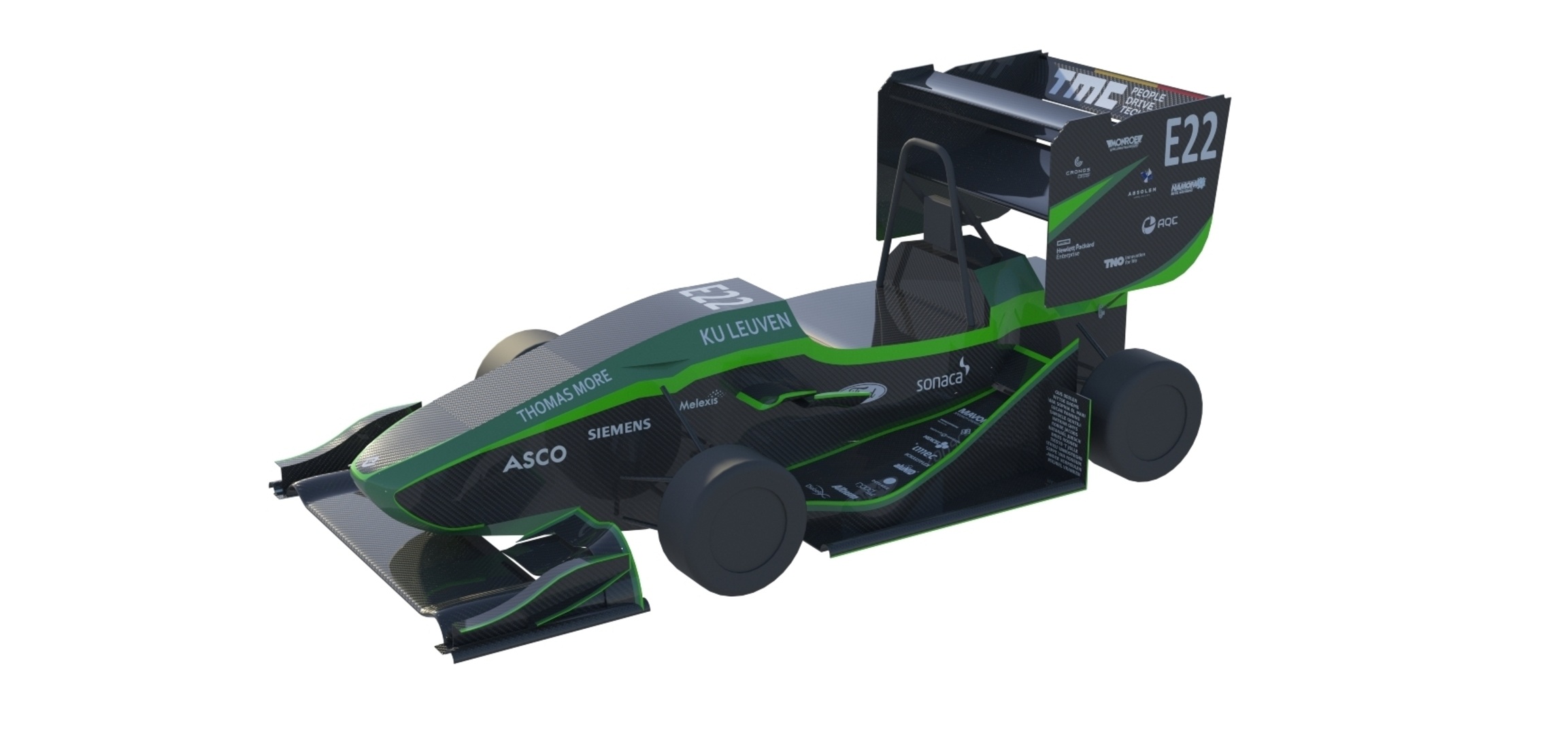
Formula Electric Belgium is proud to present the TMC Falcon, the 11th car developed by our team. It was built by a group of 60 motivated (engineering) students. This year, we focused primarily on quality and reliability, ensuring the car has been thoroughly tested. Following last year's milestone, our first participation in a driverless competition, we are committed to continuing this progress and further developing our autonomous capabilities.
Engineering Design Priorities:
Reliability
Quality
Car Specifications
General
| Frame Construction | Sandwich laminate single piece monocoque |
|---|---|
| Material | Pre impregnated carbon fibre, UD and twill weave. Aluminium honeycomb and balsa. |
| Overall L | 2860 mm |
| Overall W | 1465 mm |
| Overall H | 1196 mm |
| Wheelbase | 1535 mm |
| Track (Fr) | 1250 mm |
| Track (Rr) | 1200 mm |
| Weight with 68kg driver (Fr) | 128 kg |
| Weight with 68kg driver (Rr) | 164 kg |
| Suspension | Double wishbone pushrod, longitudinally mounted spring-damper with semi-active control. |
| Tyres (Fr / Rr) | 16.0X7.5-10, Hoosier R20 / 16.0X7.5-10, Hoosier R20 |
| Wheels (Fr / Rr) | 7.0x10, 43.5mm offset, 2 pc Carbon / 7.0x10, 43.5mm offset, 2 pc Carbon |
| Drive Type | 4WD with in-wheel electric motors |
| Cooling | side mounted twin radiator setup with 119mm electric fans for motor and drive cooling. |
| Brake System | 4-Disc system, self developed rotors with 192 mm diam., adj. brake bake balance |
| Electronics | Complete wiring harness redesign, optimized sensor integration and data acquisition. |
Powertrain
| Number of Motors | 4 |
|---|---|
| Motor Location | FR, FL, RR, RL |
| Max Motor Power (per motor) | 35 kW kW |
| Motor Type | PMSM |
| Max Motor RPM (highest) | 20000 rpm |
| Motor Controller | Lenze MOBILE DCU 30/30 |
| Max System Voltage | 600V V |
| Electrode Materials | Polymer Li-Ion (LiCoO2) |
| Combined Accumulator Capacity | 6,84kWh kWh |
| Transmission Ratio (Primary) | 1:11,36 : 1 |
Driverless System
| Processing unit(s) | Raspberry Pi 5 & Intel Core i9-12900H |
|---|---|
| Power consumption of all processing units that are working for the DV system | 200 W |
| Camera(s) | no camera's |
| Radar sensor(s) | no radar sensors |
| Lidar sensor(s) | OUSTER OS1-128 Lidar: 200m of range, 360° angle, 20Hz frequency |
| Other sensors | IMU integrated in LIDAR |
| Highlights of the DV system | Use of separate PC to run driverless system. Machine learning model to determine the color of the cones in combination of layering multiple lidar scans (multiscan) to improve cone detection vision from 8 meters up to 20 meters now. |
2024
Info
56x
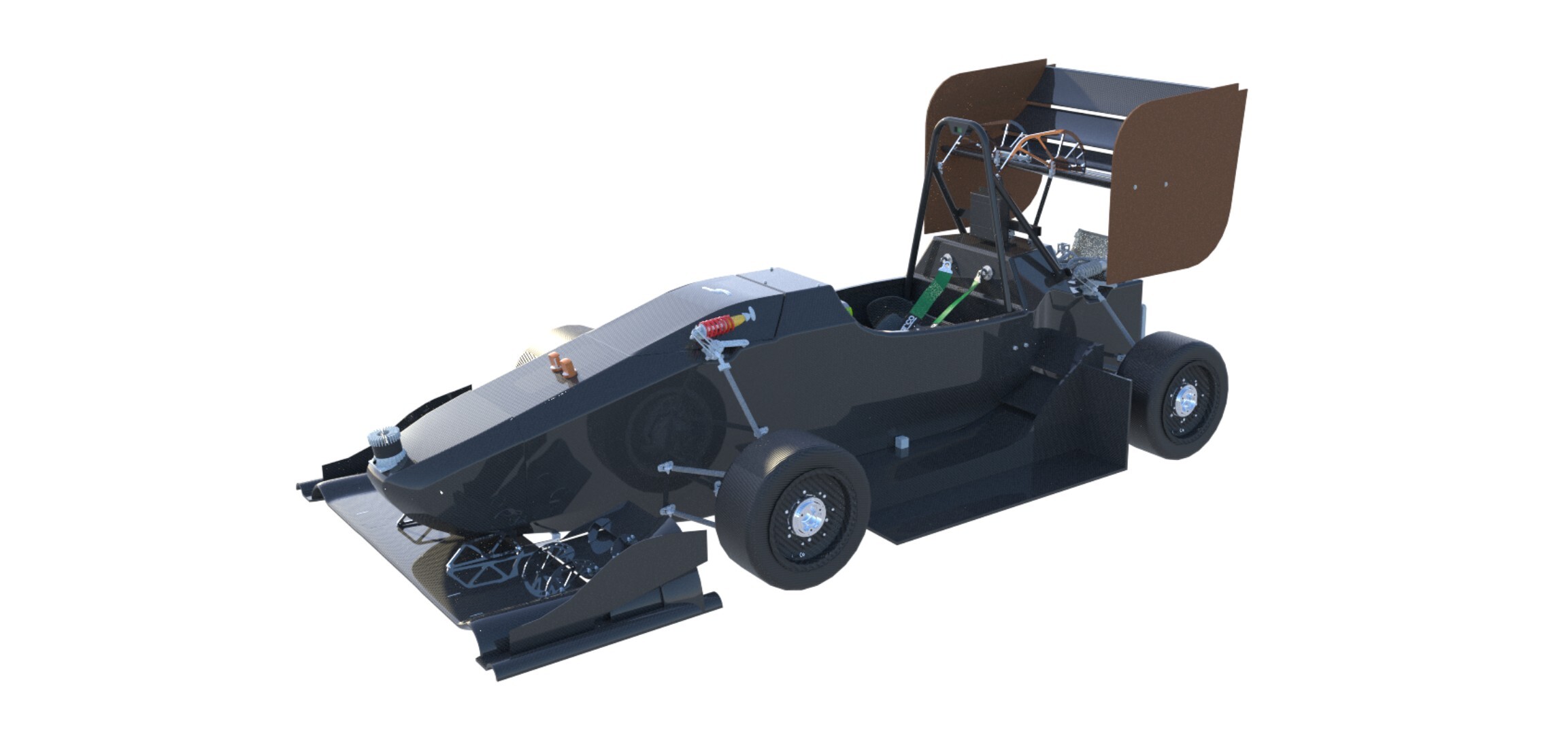
Formula Electric Belgium is a team of 50 engineering students from KU Leuven and Thomas More from different backgrounds, making it a multi-regional and interdisciplinary team. Our newest car, Comet, is our first ever driverless competition car and marks the tenth anniversary of our team. The suspension features semi-active controls and a hydraulic anti-roll bar. This year is the first year for the team to use an outrunner gearbox design housed in 10 inch custom carbon rims.
Engineering Design Priorities:
Driverless
Reliability
Weight
Ecological
Car Specifications
General
| Frame Construction | Carbon and aluminium honeycomb core sandwich laminate, single piece monocoque |
|---|---|
| Material | Pre impregnated carbon fibre, unidirectional and twill weave with aluminium honeycomb |
| Overall L | 2884 mm |
| Overall W | 1441 mm |
| Overall H | 1195 mm |
| Wheelbase | 1535 mm |
| Track (Fr) | 1250 mm |
| Track (Rr) | 1200 mm |
| Weight with 68kg driver (Fr) | 145 kg |
| Weight with 68kg driver (Rr) | 145 kg |
| Suspension | Double wishbone with pushrod, longitudinally mounted spring-damper combination |
| Tyres (Fr / Rr) | 16.0X7.5-10, Hoosier R20 / 16.0X7.5-10, Hoosier R20 |
| Wheels (Fr / Rr) | 7.0x10 43.5mm offset, 2pc carbon rim / 7.0x10 43.5mm offset, 2pc carbon rim |
| Drive Type | Compound epicyclic gearbox |
| Differential | Electronic differential (torque vectoring) |
| Cooling | Rear mounted 850cc Mini radiator and 254mm electric fan and 2 x DC centrifugal fan battery cooling |
| Brake System | 4-Disk system, self developed rotors with 198mm diam., adj. brake balance, OEM calipers |
| Electronics | Live 4G/WiFi telemetry, dashboard & screen implementing customizable buttons |
Powertrain
| Number of Motors | 4 |
|---|---|
| Motor Location | In each wheel |
| Max Motor Power (per motor) | 35kW kW |
| Motor Type | Fischer /TI085-052-070-04B7S-07S04BE2 |
| Max Motor RPM (highest) | 20000 rpm |
| Motor Controller | Lenze MOBILE DCU |
| Max System Voltage | 600 V |
| Electrode Materials | Polymor Li-Ion ( LiCoO2) |
| Combined Accumulator Capacity | 7.114kWh kWh |
| Transmission Ratio (Primary) | 1:11.36 : 1 |
| Transmission Ratio (Secondary) | / : 1 |
Driverless System
| Processing unit(s) | ECU: Digi ConnectCore 8X SBC Pro, PC: Intel Core i9-12900H |
|---|---|
| Floating Point Operations Per Second of all processing units that are working for the DV system | 1200 GigaFLOPS |
| Power consumption of all processing units that are working for the DV system | 179.93 W |
| Camera(s) | / |
| Radar sensor(s) | / |
| Lidar sensor(s) | 1 sensor, 300m range, 45°opening angle, Ouster OS1 first gen |
| Other sensors | / |
| Highlights of the DV system | The driverless system is completely new, so the focus of this year was a simple and reliable system on which the coming years can build and improve upon. This has been implemented both in code and hardware. To simplify the code, a custom trackbuilding algorithm is designed. The hardware was also designed with a focus on robustness. |
2019
Info
28x
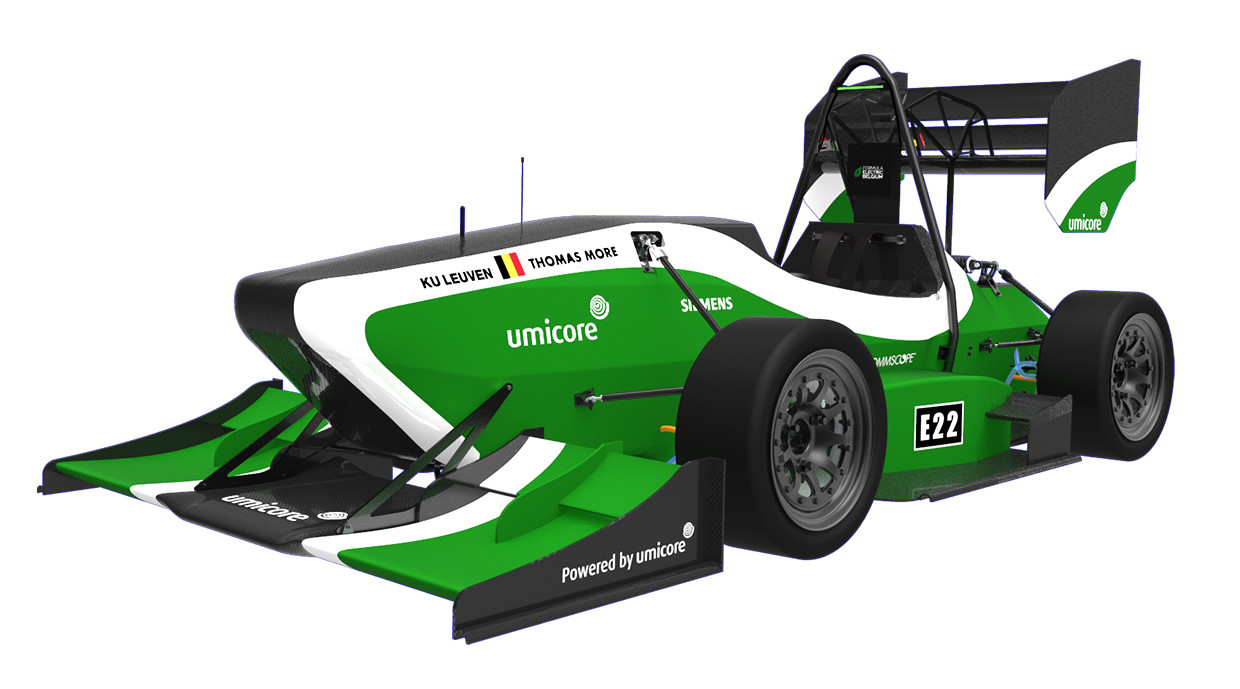
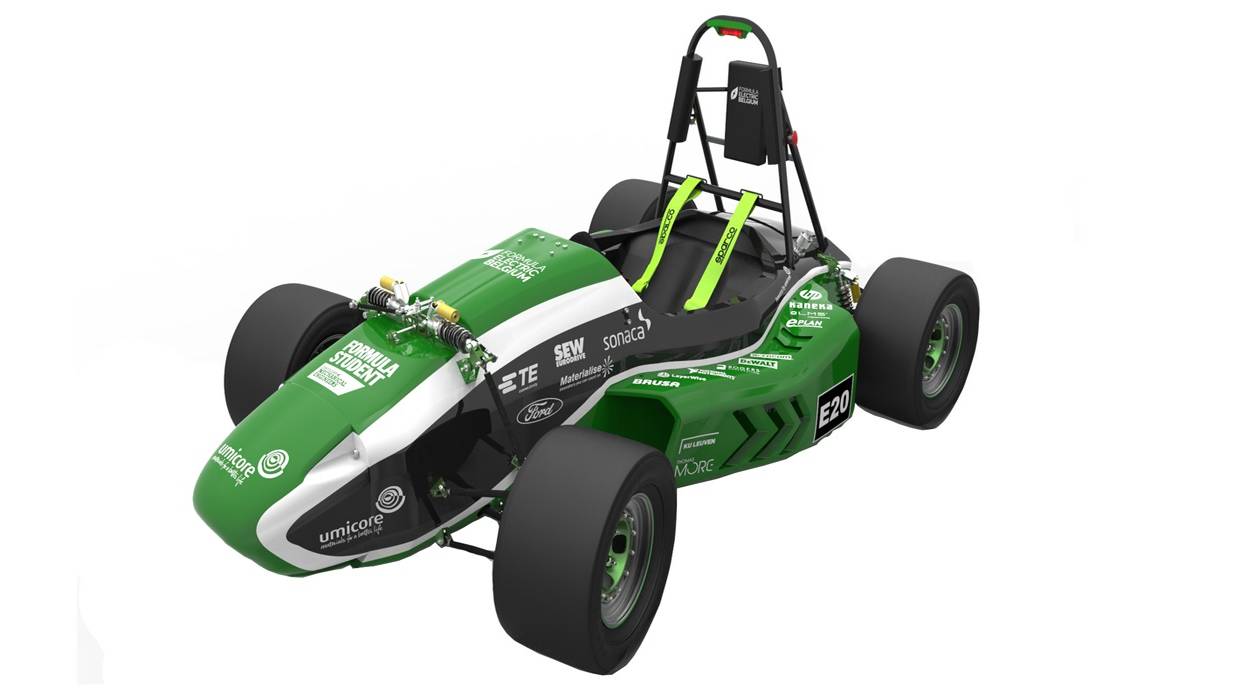
Formula Electric Belgium is a team of 40 engineering students from KU Leuven and Thomas More from different backgrounds, making it a multi-regional and interdisciplinary team. The newest car the Umicore Eclipse is their third 4WD car.It features a self-build ECU, telemetry, dashboard and integrated push-to-talk. The suspension features a decoupled pitch and roll control utilizing only two dampers per axle. The single-piece monocoque is constructed with unidirectional carbon fibre.
Engineering Design Priorities:
Single Piece Monocoque
Artificial Intelligence
Custom ECU
4-wheel drive
Data driven
Umicore Eclipse
Car Specifications
General
| Frame Construction | Single piece monocoque structure |
|---|---|
| Material | woven prepreg carbon fiber with aluminium honeycomb core |
| Overall L | 2930 mm |
| Overall W | 1425 mm |
| Overall H | 1160 mm |
| Wheelbase | 1535 mm |
| Track (Fr) | 1200 mm |
| Track (Rr) | 1150 mm |
| Weight with 68kg driver (Fr) | 123 kg |
| Weight with 68kg driver (Rr) | 145 kg |
| Suspension | Unequal Double wishbone, Push-rod, decoupled vehicle modes |
| Tyres (Fr / Rr) | 205/470 R13 - Continental |
| Wheels (Fr / Rr) | 7x13 - 1 inch offset - 2-piece construction - milled aluminium - Keizer Wheels |
| Drive Type | Compound epicyclic gearbox |
| Differential | Electronic differential (torque vectoring) |
| Cooling | Side panel mounted radiators. Cooling jacket for motors and cooling plate for drives. |
| Brake System | 4-Disk system, self developed rotors with 190 mm diameter, adjustable brake balance, AP ca |
| Electronics | Self developed ECU, Torque vectoring, push-to-talk, self designed telemetry with zigbee |
Powertrain
| Number of Motors | 4 |
|---|---|
| Motor Location | In-Wheel |
| Max Motor Power (per motor) | 37kW kW |
| Motor Type | Permanent magnet synchronous motors |
| Max Motor RPM (highest) | 20.000 rpm |
| Motor Controller | AMK-KW26-S5-FSE-4Q 2 |
| Max System Voltage | 600 V |
| Electrode Materials | Lithium-Ion / LiCoO2 |
| Combined Accumulator Capacity | 5,5kWh kWh |
| Transmission Ratio (Primary) | 15.12 : 1 |
2016
Info
19x
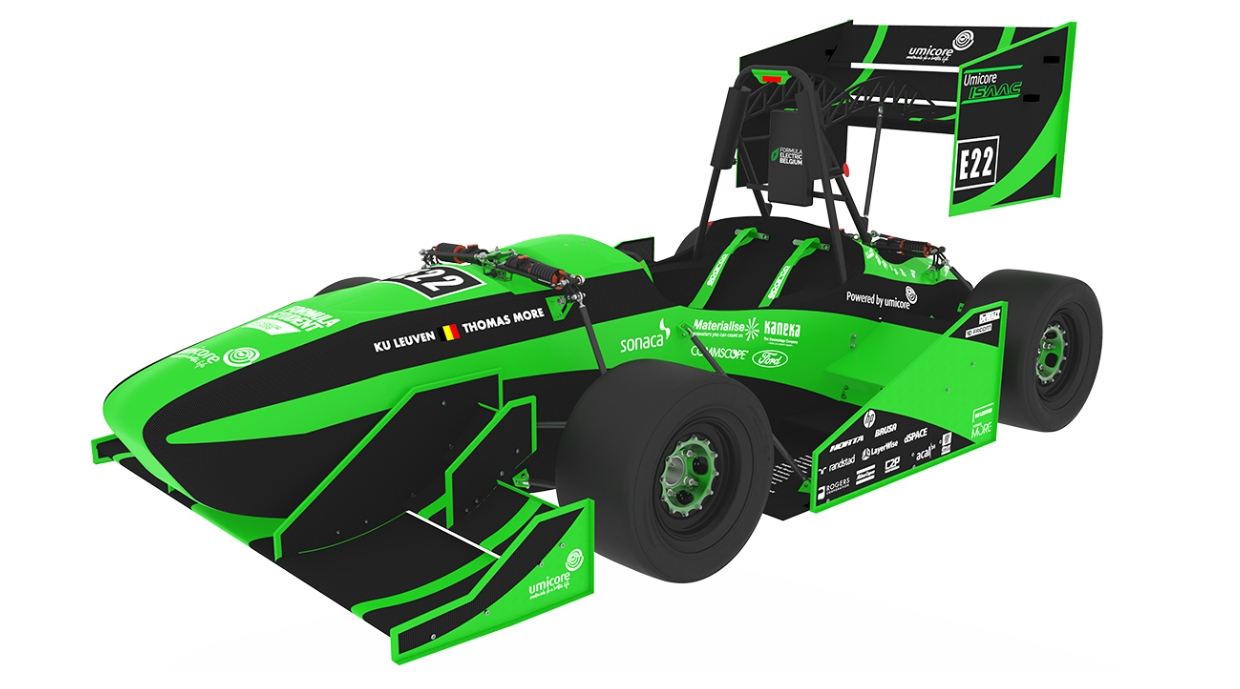
Formula Electric Belgium is a team of 37 engineering students from KU Leuven and Thomas More, making it a multi-regional team. It's focus is on optimization and reliability. A 3D printed batterycase reduces weight and improves ease of assembly, while an optimized aerodynamic package generates more downforce. Reliability is achieved through self-designed motors, a new ECU with upgraded software and a predesigned cable loom. The car also features a single piece monocoque for the first time
Engineering Design Priorities:
Reliability
Optimization
Functionality
Single Piece Monocoque
Drag Reduction System
Self Designed Motors
Car Specifications
General
| Frame Construction | Single piece monocoque structure |
|---|---|
| Material | woven prepreg carbon fiber with aluminium honeycomb core |
| Overall L | 2910 mm |
| Overall W | 1460 mm |
| Overall H | 1185 mm |
| Wheelbase | 1535 mm |
| Track (Fr) | 1200 mm |
| Track (Rr) | 1200 mm |
| Weight with 68kg driver (Fr) | 124 kg |
| Weight with 68kg driver (Rr) | 149 kg |
| Suspension | Short-Long Arm, Push-Rod actuated, Horizontally oriented springs and dampers, Semi-active damping. |
| Tyres (Fr / Rr) | 18 x 7,5-10 R25B Hoosier |
| Wheels (Fr / Rr) | 7,5 |
| Drive Type | Planetary gearbox |
| Differential | Electronic differential |
| Cooling | twin side mounted radiators with twin pumps in parallel circuits per motor. |
| Brake System | 4 hub mounted steel alloy rotors with 190mm diameter, adjustable brake balance, AP racing calipers. |
| Electronics | Self designed cable loom, dSpace ECU, DRS, Torque Vectoring, Self designed telemetry system. |
Powertrain
| Number of Motors | 2 |
|---|---|
| Motor Location | Rear Right, Rear Left |
| Max Motor Power (per motor) | 2x 60kW kW |
| Motor Type | PMSM, Self Designed, Brusa KERS Active Parts |
| Max Motor RPM (highest) | 24000 rpm |
| Motor Controller | Brusa DMC514 |
| Max System Voltage | 400V V |
| Electrode Materials | LCO - graphite |
| Combined Accumulator Capacity | 6,6kWh kWh |
| Transmission Ratio (Primary) | 10,364 : 1 |
| Transmission Ratio (Secondary) | n/a : 1 |
2015
Info
23x
Formula Electric Belgium is the one and only Formula Student team in Belgium. These two teams are merged now and became one, namely Formula Electric Belgium (FEB). FEB focuses on weight reduction and reliability. Weight reduction throught optimization of every single component. The second Belgium formula student monocoque weighs 30% less than the first one.
Engineering Design Priorities:
Self-built motors
CFRP Monocoque
Cable loom
One team in Belgium
Car Specifications
General
| Frame Construction | CFRP Monocoque |
|---|---|
| Material | Aluminium Honeycomb |
| Overall L | 2400 mm |
| Overall W | 1480 mm |
| Overall H | 1090 mm |
| Wheelbase | 1525 mm |
| Track (Fr) | 1200 mm |
| Track (Rr) | 1200 mm |
| Weight with 68kg driver (Fr) | 115 kg |
| Weight with 68kg driver (Rr) | 152 kg |
| Suspension | Short-long arm, push rod / Short-long arm, pull rod |
| Tyres (Fr / Rr) | 18 x 7,5-10 R25B Hoosier |
| Wheels (Fr / Rr) | 7,5 |
| Drive Type | Planetary gearbox |
| Differential | Electronic differential |
| Cooling | self made made housing with integrated gearbox and cooling |
| Brake System | 4-Disk system, adjustable brake balance |
| Electronics | Optimized cable loom, Multifunctional dashbaord & steering wheel |
Powertrain
| Number of Motors | 2 |
|---|---|
| Motor Location | 2 motors, middle most rea |
| Max Motor Power (per motor) | 120kW kW |
| Motor Type | Permanent magnet motor |
| Max Motor RPM (highest) | 14000 rpm |
| Motor Controller | BRUSA DMC514 |
| Max System Voltage | 400V V |
| Electrode Materials | Li-ion / LCO |
| Combined Accumulator Capacity | 7.56kWh kWh |
| Transmission Ratio (Primary) | 10.36 : 1 |
2014
Info
5x
Formula Group T consists of 22 master students in Industrial Engineering Sciences at the University of Leuven, Campus Group T, Belgium. June will be our third car and several improvements have been made to increase the performance, handling and the efficiency. In comparison to last year, there we achieved a 20% weight reduction. Events 2014: FSUK, FSGermany and FSSpain
Engineering Design Priorities:
3D-printing
Carbon Fiber Monocoque
Lightweight and Compact
Aero
Self-developed
Ergonomics
Car Specifications
General
| Frame Construction | Carbon Monocoque |
|---|---|
| Material | 5 layers of woven carbon fibre in alternating 0 and 45 degrees patern with 25mm diab core |
| Overall L | 2700 mm |
| Overall W | 1390 mm |
| Overall H | 1080 mm |
| Wheelbase | 1525 mm |
| Track (Fr) | 1200 mm |
| Track (Rr) | 1150 mm |
| Weight with 68kg driver (Fr) | 146 kg |
| Weight with 68kg driver (Rr) | 147 kg |
| Suspension | Double unequal length A-Arm. Pull rod actuated vertically oriented spring and damper |
| Tyres (Fr / Rr) | Hoosier slicks 20.5 x 7.0 – 13 R25B, 7 inch Keizer 13 Inch Al/ Mg Rim |
| Wheels (Fr / Rr) | Hoosier slicks 20.5 x 7.0 – 13 R25B, 7 inch Keizer 13 Inch Al/ Mg Rim |
| Drive Type | Epicyclic gear reduction |
| Differential | electronic differential with traction control |
| Cooling | black ice stealth 360 radiator, 3 X 120mm electric fans, Behind the driver located |
| Brake System | 4-Disk system, self developed 220mm diameter, adjustable bias bar, 4 piston dual circuit caliper |
| Electronics | Multifunctional steering wheel, self designed PIC 32 ECU, wiring harness sealed to IP65 |
Powertrain
| Number of Motors | 2 |
|---|---|
| Motor Location | Rear Right, Rear Left |
| Max Motor Power (per motor) | 85 kW kW |
| Motor Type | Enstroj Emrax 207/70kW peak axial flux motor |
| Max Motor RPM (highest) | 5000 rpm |
| Motor Controller | 2X Bamocar D3 |
| Max System Voltage | 598 V |
| Electrode Materials | Melasta SLPBA542124 Lithium polymer |
| Combined Accumulator Capacity | 5,86 kWh kWh |
| Transmission Ratio (Primary) | 3,52:1 : 1 |
| Transmission Ratio (Secondary) | 3,52:1 : 1 |
2012
Info
Formula Group T was founded in the summer of 2011 and consists of 16 Master students in Engineering. In the car, which is called Areion, the team has implemented three innovative technologies. The first one is the use of state-of-the-art thermoplastic biocomposites. Within an European Research project, the team developed a biocomposite race seat for Areion. This seat will be the demonstrator of this project. Throughout our car, you will notice an intensive use of additive manufacturing for the fabrication of complex, functional and lightweight components, in both plastic and metals. Formula Group T has used this technology for producing the body and several parts of the suspension. Thirdly, the electric drivetrain is a technological masterpiece. Beside the use of a powerful motor we developed a contactor mechanism that can change between “wye-delta” in less than 1/10th of a second while driving. In this way, both maximum performance and optimal efficiency are possible.
Car Specifications
General
| Frame Construction | Steel tubular spaceframe |
|---|---|
| Material | E235 and E355 steel round tubing with diameter 25mm and wall thicknessess from 0,8 to 2,5 mm |
| Overall L | 2890 mm |
| Overall W | 1410 mm |
| Overall H | 1250 mm |
| Wheelbase | 1600 mm |
| Track (Fr) | 1200 mm |
| Track (Rr) | 1150 mm |
| Weight with 68kg driver (Fr) | 157 kg |
| Weight with 68kg driver (Rr) | 191 kg |
| Suspension | Double unequal length A-Arm. Push rod actuated horizontally oriented spring and damper. Adj. Rollbar |
| Tyres (Fr / Rr) | Hoosier 20.5 x 7.0-13 R25B |
| Wheels (Fr / Rr) | 7 inch wide, Keizer 7x13 Mag Rim, 2 inch neg. offset |
| Drive Type | Chain drive, 520 type, 66 links |
| Differential | Drexler Limited slip differential Version 1 |
| Cooling | Liquid cooled motor and drive/ radiator located in sidepod |
| Brake System | Solid rotor, Cast Iron, hub mounted, 240mm dia. vented; Dual piston 30mm dia., fixed mtg |
| Electronics | Dash mounted torque, batterie status, wheel speed, temperatures, acceleration; Main ECU: Compact RIO |
Powertrain
| Number of Motors | 1 |
|---|---|
| Motor Location | Rear left |
| Max Motor Power (per motor) | 167.5kW kW |
| Motor Type | EVO Electric AFM-140-3 PM Syn. Axial Flux |
| Max Motor RPM (highest) | 5000 rpm |
| Motor Controller | SKAI 45 |
| Max System Voltage | 498V V |
| Electrode Materials | Li[NiCoMn]O2 |
| Combined Accumulator Capacity | 8.76kWh kWh |
| Transmission Ratio (Primary) | 3.4 : 1 |
| Transmission Ratio (Secondary) | n/a : 1 |
FS past achievements due to World Ranking Data Base
| Date | Event | Teams | Rank | BP | CM | ED | SP | DV SP | AC | DV AC | AX | EN | EF | Pe | Total |
|---|---|---|---|---|---|---|---|---|---|---|---|---|---|---|---|
| 2026.08 | 40 |
11. |
35. |
17. |
2. |
10. |
- |
4. |
- |
4. |
11. |
- |
-40.00 |
282.90 |
|
| 2026.08 | 38 |
4. |
15. |
15. |
10. |
8. |
- |
5. |
- |
5. |
4. |
1. |
0.00 |
725.70 |
|
| 2026.07 | 52 |
13. |
19. |
27. |
29. |
- |
- |
- |
- |
- |
7. |
1. |
0.00 |
433.85 |
|
| 2025.08 | 84 |
18. |
36. |
28. |
27. |
30. |
- |
25. |
13. |
25. |
17. |
18. |
0.00 |
501.90 |
|
| 2025.08 | 53 |
10. |
17. |
18. |
29. |
23. |
- |
14. |
- |
12. |
11. |
9. |
0.00 |
539.60 |
|
| 2025.07 | 44 |
6. |
8. |
17. |
9. |
16. |
- |
- |
- |
16. |
6. |
3. |
0.00 |
501.92 |
|
| 2024.08 | 79 |
42. |
53. |
31. |
18. |
35. |
- |
- |
- |
35. |
- |
- |
0.00 |
237.63 |
|
| 2024.08 | 47 |
24. |
44. |
16. |
18. |
18. |
- |
11. |
- |
12. |
- |
- |
0.00 |
259.98 |
|
| 2024.07 | 31 |
16. |
22. |
20. |
15. |
- |
- |
13. |
- |
- |
- |
- |
0.00 |
231.79 |
|
| 2023.08 | 29 |
19. |
19. |
10. |
15. |
18. |
- |
8. |
- |
14. |
- |
- |
0.00 |
309.00 |
|
| 2023.08 | 31 |
7. |
5. |
19. |
11. |
- |
- |
11. |
- |
- |
6. |
5. |
0.00 |
564.16 |
|
| 2023.07 | 33 |
20. |
23. |
18. |
7. |
- |
- |
- |
- |
- |
- |
- |
-50.00 |
176.67 |
|
| 2022.08 | 25 |
7. |
9. |
11. |
5. |
14. |
- |
6. |
- |
12. |
8. |
2. |
-30.00 |
559.90 |
|
| 2022.08 | 33 |
15. |
15. |
31. |
9. |
18. |
- |
14. |
- |
11. |
5. |
- |
0.00 |
290.64 |
|
| 2022.07 | 21 |
17. |
18. |
17. |
16. |
- |
- |
- |
- |
- |
- |
- |
0.00 |
161.43 |
|
| 2021.08 | 26 |
23. |
15. |
23. |
14. |
20. |
- |
20. |
- |
- |
- |
- |
0.00 |
262.99 |
|
| 2021.08 | 14 |
6. |
- |
2. |
2. |
5. |
- |
4. |
- |
3. |
- |
- |
0.00 |
289.06 |
|
| 2021.07 | 28 |
17. |
17. |
15. |
17. |
- |
- |
- |
- |
- |
- |
- |
-5.00 |
176.97 |
|
| 2019.08 | 15 |
8. |
8. |
10. |
6. |
8. |
- |
3. |
- |
9. |
- |
- |
0.00 |
369.95 |
|
| 2019.08 | 38 |
17. |
8. |
33. |
17. |
20. |
- |
5. |
- |
19. |
- |
- |
0.00 |
282.39 |
|
| 2019.07 | 25 |
10. |
11. |
10. |
7. |
- |
- |
- |
- |
10. |
- |
- |
0.00 |
260.17 |
|
| 2019.07 | 21 |
10. |
10. |
7. |
4. |
- |
- |
- |
- |
- |
- |
- |
0.00 |
265.63 |
|
| 2017.08 | 14 |
10. |
11. |
11. |
4. |
- |
- |
- |
- |
7. |
8. |
- |
0.00 |
297.88 |
|
| 2016.08 | 29 |
16. |
16. |
23. |
10. |
- |
- |
11. |
- |
11. |
14. |
- |
0.00 |
324.00 |
|
| 2016.08 | 37 |
24. |
20. |
10. |
25. |
14. |
- |
11. |
- |
- |
- |
- |
-20.00 |
241.59 |
|
| 2016.07 | 106 |
57. |
44. |
61. |
15. |
- |
- |
- |
- |
- |
- |
- |
0.00 |
217.00 |
|
| 2015.09 | 13 |
4. |
3. |
3. |
2. |
10. |
- |
9. |
- |
6. |
5. |
5. |
0.00 |
623.32 |
|
| 2015.08 | 39 |
16. |
18. |
6. |
23. |
10. |
- |
7. |
- |
14. |
- |
- |
0.00 |
297.40 |
|
| 2015.07 | 92 |
38. |
49. |
40. |
7. |
- |
- |
- |
- |
31. |
- |
- |
0.00 |
265.10 |
|
| 2014.08 | 23 |
15. |
10. |
13. |
11. |
11. |
- |
16. |
- |
12. |
- |
5. |
0.00 |
391.08 |
|
| 2014.08 | 39 |
23. |
11. |
30. |
20. |
- |
- |
16. |
- |
17. |
- |
- |
0.00 |
241.11 |
|
| 2014.07 | 90 |
50. |
10. |
45. |
51. |
- |
- |
- |
- |
- |
- |
- |
0.00 |
193.60 |
|
| 2013.08 | 39 |
28. |
33. |
35. |
28. |
15. |
- |
20. |
- |
24. |
19. |
- |
0.00 |
274.57 |
|
| 2013.07 | 83 |
41. |
32. |
23. |
28. |
36. |
- |
- |
- |
34. |
58. |
- |
0.00 |
302.10 |
|
| 2012.09 | 17 |
11. |
9. |
- |
8. |
10. |
- |
2. |
- |
12. |
9. |
9. |
0.00 |
322.91 |
|
| 2012.08 | 32 |
11. |
19. |
23. |
24. |
23. |
- |
7. |
- |
14. |
8. |
8. |
0.00 |
430.03 |
|
| 2012.07 | 97 |
52. |
83. |
11. |
25. |
- |
- |
- |
- |
- |
- |
- |
-2.00 |
196.90 |
|
| x 37 | |||||||||||||||